These days, it’s easy to let political frustration well up a bit. We like to think that, given the keys to the city, we’d do better than a real politician. “It’s so simple!” you might say. “Give people what they ask for, take care of them, and there won’t be any problems.”
For better and worse, Urban Empire lets you explore that idea–or, at least, more than some of its iconic cousins. SimCity, for example, lets you take the reins of a nascent city, but it came with some huge limitations in terms of what sorts of decision-making powers you can wield. Urban Empire unshackles you, but in so doing gives you a sobering dose of reality. As the leader of your city, you can push for women’s rights or abolish child-labor laws–but you’re always at the behest of a fickle city council. That addition makes Urban Empire one of the most realistic (and, at times, most frustrating) city-building simulators around.
When the game starts, you’ll have unchecked power, taking control of a political family with blessings from the emperor of the fictional country Swarelia. You can’t be removed from office, and you can’t run dry on money, either. If you get into trouble, you can run to the emperor and get a fat check and an easy bailout–though you’ll lose a bit of political clout. Beyond that, you’re free to push for whatever improvements and projects you’d like. Along the way, however, you’ll also be making decisions about how you, personally, live your life. You may choose to send your eldest child (and your future successor) to a boarding school abroad, which could affect their reputation years down the line. That gives you a strong tie not only to the city you build, but also to the narrative of your family across many generations.
You’ll also be in charge of zoning and organizing new districts, as well as deciding which types of technologies to bring to your fine city. As you progress, you can unlock sewage, electricity, and new types of roads, all the way up to robotics and sci-fi-inspired gizmos. Each new district will have an up-front cost to build out the necessary infrastructure, and then monthly maintenance that you’ll have to keep in check as you turn on more and more services. That tension between the cost of different services and infrastructure upgrades, your own goals, and the capriciousness of the council members (each of whom have their own constituents to appease) is an excellent, sturdy foundation for this management sim.
Running water for all sounds nice, but unless your city is packed tight, it’s a tough expenditure to justify. And even if you do have the money, you’ll first have to propose whatever change you want to make, and then wait a few months as the city council deliberates on the change. As they bicker, you can spend political goodwill, call in favors, or make sweeping threats to sway the parties–each of which comes with consequences. It’s a complex (albeit exhausting) system that reflects the struggles of politicians at almost every level of government.
As political parties evolve, their core values will twist and morph, until they’ve splintered into their component factions. While these shifts are unfortunately the same for each campaign, limiting replayability, they do provide an engaging challenge and an organic system for ramping up difficulty. To ram through critical legislation, you may need to play one group off another, making and breaking alliances as you go. This goes double for controversial social policies where you can’t always make an easy-to-grasp economic case. As a general rule, though, if the city is prospering and you’re well liked, you won’t have much trouble getting your work done. The issue is that as you play, you’re repeatedly reminded that understanding the city’s well-being can be so difficult as to seem random–at least at first.
Most of your time with Urban Empire will be spent monitoring your cash flow. At first, these numbers will be pretty easy to manage–a few grand each month, slotted straight into the city’s coffers. But Urban Empire begins during the industrial revolution, an era notorious for political and economic instability, and shocks to your municipal economy will come fast and hit hard, often jarring your income substantially in either direction. Those fluctuations appear random–and, to be sure, some are–but if you dig a bit, you’ll often find some sort of economic bottleneck. A district you built early on might be struggling to cope with excessive traffic, limiting productivity, or an industrial sector may need a power plant and electrical grid to stay competitive.
Urban Empire supplies you with all the data you need to find these hiccups–or, rather, it tries to. You can (and should) drill down to individual businesses and homes to see everything from the area’s political makeup to its business climate. Different edicts and ordinances will cause shifts in supply and demand, and that works in concert with your city’s external connections–like rail stations and ports–to generate the simulation of your city’s economic performance. That data can be tedious to sort through, and there’s not much in the way of tools to monitor broad sections of the city. Everything gets organized by district, and that can make it tough to determine how different areas are working together or what’s driving different types of demand.
Making matters worse is a nebulous, unpredictable blob of bugs that will, at some point, obfuscate critical information. Many edicts and technologies will show you a summary of their costs and effects if you hover the mouse over them, but that information won’t appear at unpredictable points. Sometimes you can close the game and restart to get it back on screen, but once in a while, Urban Empire will crash at the main menu. These issues aren’t killers, but they’re annoying and have no place in a retail game.
Bugs aside, one solution to overabundance of information is actually simple, and it’s something Urban Empire already does–but only for some of its features. Different tools are gated off based on your technological progress. For example, you cannot start with differential taxation. You’re stuck raising or lowering taxes on businesses and citizens until you’ve done the social research needed to tax industry–for example–at a higher rate than corporations. That keeps parts of the game hidden away until you’ve developed more familiarity with how things work. The problem is that not everything in the game works like this, and as you move through time, you’ll be saddled with an enormous amount of management that doesn’t get a proper introduction or a safe means of experimenting with different effects. This tendency causes some major difficulty spikes that take far too long to overcome.
At the same time, many of these features come across as intentional. Playing the game doesn’t quite feel fatalistic, but it does seem to bludgeon players with the idea that politicking is harder than most of us will admit. To that end, Urban Empire is quite the achievement. It’s incredible to watch your own political empire collapse or thrive based on the butterfly effect of decisions both big and small.
Urban Empire is a trying game, but there’s beauty in how it captures the many obstacles that plague political life, but it’s still marred by instances of poor execution and an unwieldy user interface. Still, if you’ve ever wanted to know what a more realistic, less tongue-in-cheek rendition of SimCity would be like, you could do a lot worse. If you’re willing to spend the time, Urban Empire has a lot to show you, but it comes with its share of annoyances.
Overwatch is an exercise in refined chaos. There are multitudes of layers hiding beneath the hectic surface, and they emerge, one after another, the more you play. This is a shooter that knows how to surprise, one that unfolds at a frantic pace, one that takes a handful of great ideas, and combines them into something spectacular.
At first glance, it’s a simple formula: two teams of six vie for control of mobile payloads, capture points, and key strategic positions. Each of its four modes are easy to grasp, serving as the foundation for the various maps and the powerful heroes colliding within them. That apparent simplicity is deceiving, though. Overwatch is an amorphous, shapeshifting organism that mean different things for different players, depending on which hero you choose, and what role you assume within the context of your team.
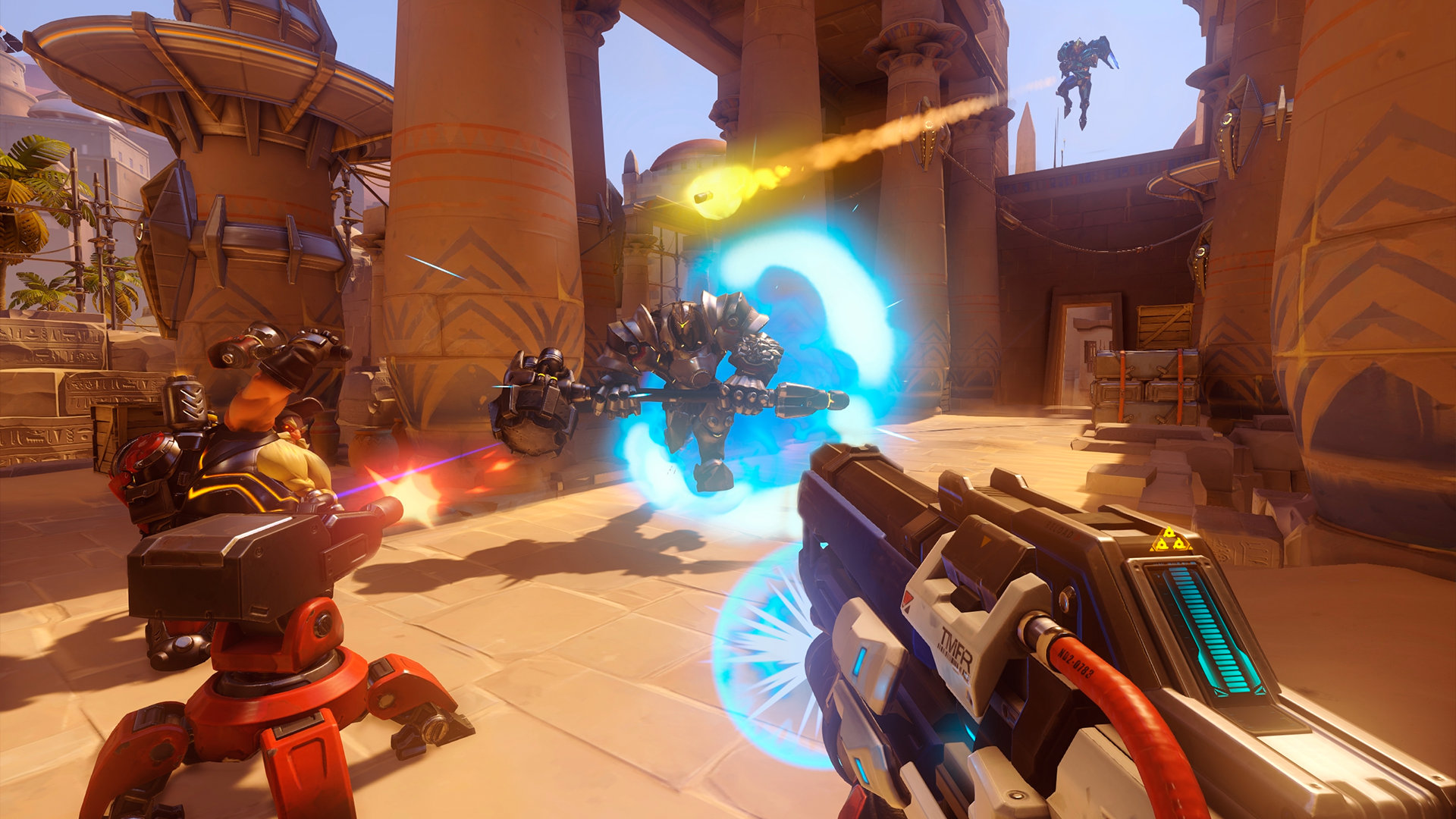
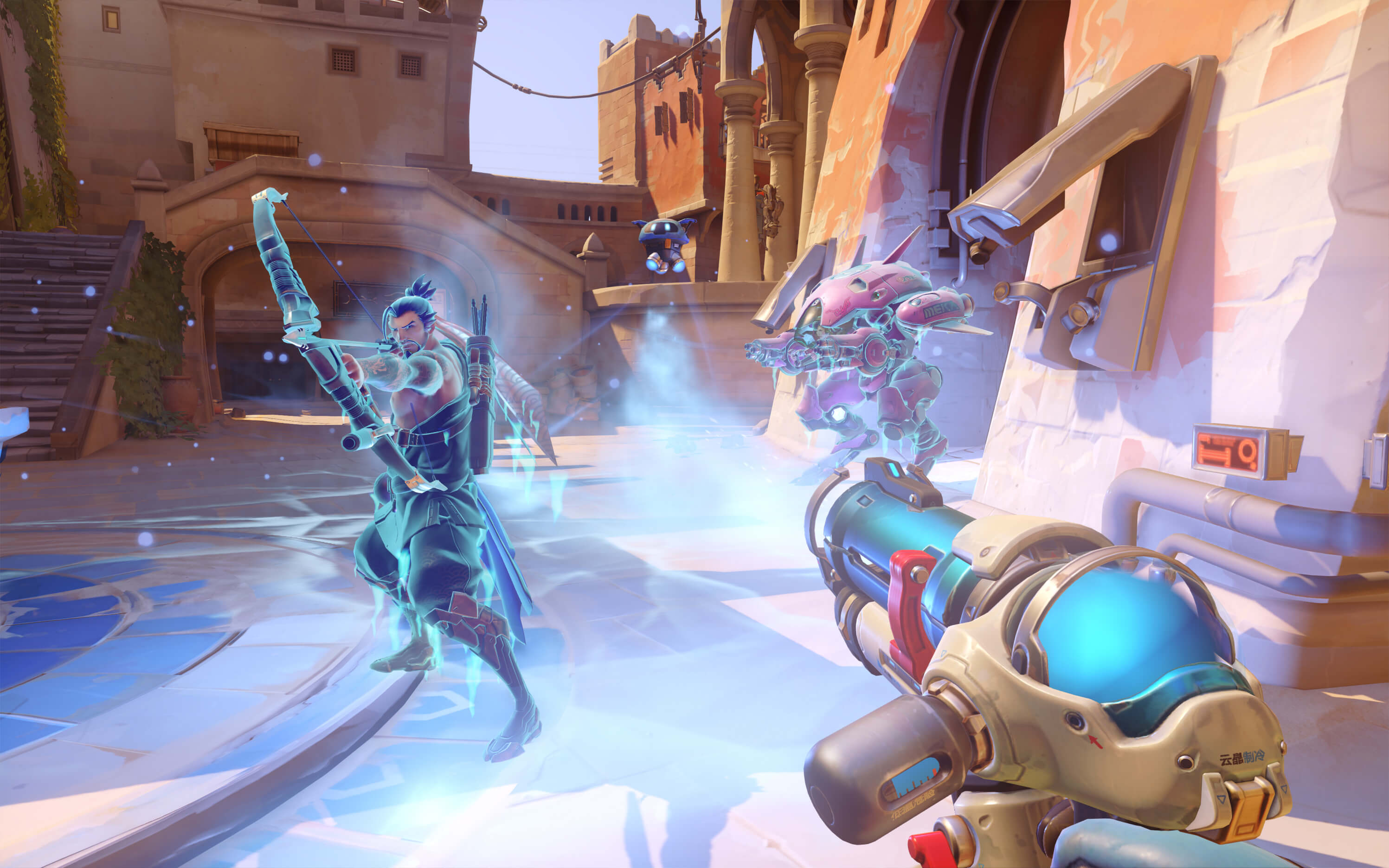
The quality of Overwatch, as a hero shooter, relies on its fighters. And these 21 heroes, both in terms of personality and design, compose one of the more distinct and diverse casts in recent memory. Their dialogue hints at relationships among the group. Their art design conveys a stark visual vocabulary. Their abilities set the stage for multidimensional firefights with explosions, energy shields, and bursts of sonic energy. There’s an enticing balance between mastering one character and trying someone completely new.
Each of these characters could be the center of their own game. There’s the dwarf engineer Torbjörn and his upgradeable defensive turret. There’s the ape scientist Winston, with both superior intellect and animalistic rage. Then there’s Tracer, the British pilot removed from the rules of space and time, warping around the battlefield and reversing her actions to correct mistakes she might have made seconds before.
Like Tracer, Overwatch functions as a sort of time machine, borrowing elements from the shooter genre throughout its evolution over the years. Some of Overwatch’s characters display the arena combat of Quake, while others capture the dynamism of the more modern Titanfall. Overwatch’s cast also includes a more archetypical military-shooter character, Soldier 76. He serves as a gateway for players more accustomed to Call of Duty or Battlefield, ushering them into a more nuanced and versatile overall experience.
These heroes may be the bricks comprising Overwatch’s structure, but the map design is the mortar in between. Skirmishes play out across 12 locales in a futuristic version of Earth, from the foundries of industrial Russia to the shrines of rural Japan. These arenas mix high walkways and low pits, narrow sightlines with wide avenues. Battles change constantly, choke points become virtual morgues, and learning to use your character’s range, damage, and special abilities is contingent on what the environments dictate. Variety in map design is one thing–precision in their layout is another entirely. And Overwatch is precision incarnate.
What’s impressive isn’t Overwatch’s ambition–its attempt to bring all these different factors together under one roof. What’s impressive is that it fits these characters and interactions into an organic being, with ever-changing scenarios that keep Overwatch fresh through each match. It helps that you can switch heroes mid-match according to the ebb and flow of each situation.
There’s an enticing balance between mastering one character and trying someone completely new, and watching new layers unravel.
But even more vital is the ease with which Overwatch teaches you valuable lessons. Playing becomes a digging process, and as you discover new ways to use each character on each map, how better to serve your team, and how to counter your most dangerous opponents, Overwatch’s deepest layers begin to emerge.
Imagine defending the last waypoint in Japan as the attackers escort their explosive payload to within yards of victory. Your team is spread around the room, on the upper catwalks and out in the open, standing in the way and keeping the opponents at bay. As the explosive expert Junkrat, you’re launching grenades into clumps of enemies. You’re laying bear traps to cover the walkway at your rear. You’re disrupting the position of shield characters with the blast from your remote mines.
But you’re also watching your teammate’s back as she snipes with Widowmaker. You’re calling out enemy positions to Pharah as she glides above the fray with her rocket launcher ablaze. You’re coordinating with Zarya, waiting until both of your ultimate abilities are ready. And as she launches her Graviton Surge into the room, sucking every enemy into one concentrated mass, you release your RIP-Tire explosive, steering it into the group and killing them all, buying your tank characters precious seconds to reverse the payload as the timer reaches zero and you win the match with bated breath.
Overwatch’s maps depict a science-fiction utopia on the brink of conflict.
This is what Overwatch does to your brain. These are the thoughts that race through your head. These are the scenarios that encourage you to play the game in such ways. There’s even a post-match voting period in which you congratulate individual efforts, whether it be the amount of hit-points Mercy healed, the number of warp portals Symmetra erected, or the percentage of damage Reinhardt blocked with his shield. In these moments, Overwatch is telling you one important thing: there is no single way to play.
Unfortunately, it sometimes ignores this mantra. The end of each match initiates a “Play of the Game” highlight, which showcases the most impressive moment from the perspective of the player who performed it. However, unlike the post-match voting period, the highlight video almost always focuses on killstreaks. These are flashy–especially when the player shows a clear mastery of Reaper’s close-quarters attacks, or Genji’s ninja-star barrages–but they don’t recognize healers or tank characters enough. It’s a minor complaint, and only stands out because the rest of Overwatch is so accommodating to individual playstyles–but it’s jarring nonetheless.
It’s also disappointing how, for every way Overwatch rewards mastery of your favorite characters, it stumbles with its randomized loot system. These awards are all aesthetic, to be clear–a new character skin here, a new celebration stance there–but too often loot crates contain unwanted items. More importantly, they delay the process of outfitting your favorite characters, the ones you use most often, the ones you grow attached to. You can accrue Overwatch gold to unlock specific items, but like the items themselves, gold is strewn throughout random loot crates. In this respect, Overwatch uses gambling to undermine your desire for specific unlocks.
There is a genuine learning process here. There is real value to the time you spend understanding these overlapping systems.
But in almost every other way, Overwatch encourages a more tangible sort of progression: that of filling a critical role on your team and understanding its intricacies the more you play, adapt, and grow. There is a genuine learning process here. There is real value to the time you spend understanding these overlapping systems.
It’s that intoxicating path of discovery that makes Overwatch so varied, so rewarding, and ultimately another seminal release from developer Blizzard. Overwatch is an intelligent cascade of disparate ideas, supporting one another, pouring into one another, and coiling around themselves as they flow into the brilliant shooter underneath.
What is it? First-person survival horror that returns to the series’ roots. Expect to pay £40/$60 Developer Capcom Publisher In-house Reviewed on Radeon RX 480, Intel i7-5820K, 16GB RAM Multiplayer None Buy itHumble store
Ethan Winters drives deep into the Louisiana bayou to find his missing wife. We follow his car from above, a tiny speck against a vast expanse of remote, isolated swampland. The setting sun casts a gloomy orange glow over the landscape, giving you a creeping sense of foreboding. If you get lost or go missing—or worse—out here, who would ever know? It’s a beautiful, evocative shot, and almost certainly an homage to the Torrance family’s yellow car snaking through the Colorado mountains at the beginning of The Shining. But Resident Evil has always been inspired by horror cinema, even if recent entries in the series have been more Uwe Boll than Stanley Kubrick.
This understated opening immediately sets the tone for Resident Evil 7. It’s a return to the atmospheric, slow-burning horror of the original, with a few nods to contemporary games like Alien: Isolation and Amnesia. The shift to a first-person perspective might suggest it’s a bold reinvention of the series, in the same way Resident Evil 4 was, but it really isn’t. It’s classic Resident Evil through and through, with healing herbs, item boxes, elaborate puzzles, and shambling monsters. But the convoluted mythology, overripe melodrama, and absurd action set-pieces that plagued the last few games have been sidelined for something more subtle and refined.
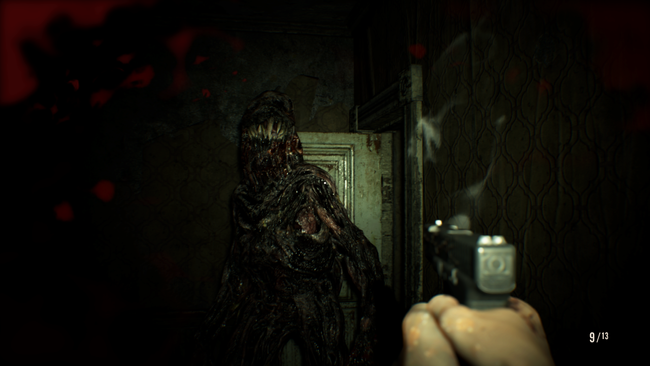
To be fair, the first hour—before item management and weapons are introduced—is different to anything Capcom has ever done before. It’s a brilliantly paced, cleverly designed parade of scares set in a dilapidated old house. The fear of what lies around each darkened corner, and your inability to defend yourself, gives you a powerful feeling of tension and unease. It uses jump scares and psychological trickery to whittle away at your nerves, and it’s probably the scariest the series has ever been. But as soon as I had a 9mm pistol in my hand, and found myself juggling items in my inventory and using arcane objects to unlock doors, I felt right at home.
That’s not to say the game stops being scary the moment you find a gun. Not only is ammunition a near-constant luxury, but certain enemies can’t be killed at all, forcing you to sneak past them. You can attack them, and they disappear for a while, but they soak up so many bullets that it’s often a poor trade. You always feel vulnerable, even when you’re cradling a shotgun or grenade launcher, because you never know what the game’s going to throw at you next. One of its greatest strengths is keeping you on your toes and mischievously second-guessing you, throwing in a scare when you least expect it, resisting when the moment seems obvious.
Confidence comes in waves. You’ll find ammo and feel unstoppable. Then you’ll find yourself locked in a small room with an enemy, waste all your bullets by firing at it in a bland panic, and suddenly feel helpless again. However, there are a few moments, mostly in the last third of the game, where you have an abundance of ammunition and can merrily shoot any monstrosity that crosses your path. These sections almost feel like a reward for your many hours of careful ammo conservation and patient sneaking, and are hugely cathartic. But just as you’re delighting in your newfound power, it’s snatched away.
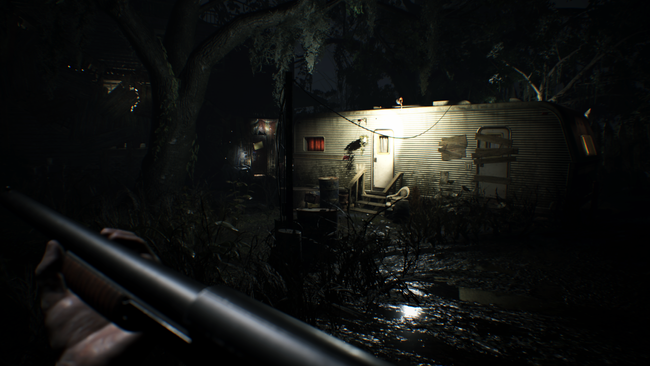
The early hours are spent in and around an old house owned by the reclusive Baker family. It’s a disgusting, rotten place—a far cry from the grand Spencer mansion—and rendered in astonishing detail. You can almost smell the mouldering food and stale, dusty air as you explore, and the building creaks and groans like a dying animal as it’s battered by the wind. There’s a grimy, almost tangible realism to the visuals, and the audio design is sensational too. You can easily track the shuffling footsteps of an enemy by ear, gauging where they are based on sound alone. And the creaking floorboards and sinister sounds that echo around you only add to the rumbling sense of dread felt in every room of this dreary homestead.
But you don’t spend the entire game in the house. There’s a surprising amount of variety here, and it never lingers on one location or situation for too long. Not once did I feel like the game was artificially extending its length with backtracking or filler—something even the best games in the series are guilty of. And during the nine hours it took me to finish it, it was constantly surprising me with new ideas, locations, and story revelations. I won’t go into specifics, because it’s a game that should be played blind, but there are some nice pace changes and shifts in rhythm that jolt you out of your comfort zone.
One of my favourite features, but one I wish they’d made more of, is the use of flashbacks. Find a VHS tape and slide it into a video player and you’ll relive events from the past. In one tape you’re part of a TV crew filming a low-budget paranormal investigation show in the Baker family’s guest house. These little standalone vignettes are wonderfully creepy, and I like how they sometimes reveal something that will help Ethan later on—like the location of a hidden switch. But there are only a handful of them to discover, and I feel like they should have been a much bigger part of the game.
The move to first-person is not as revolutionary as you might think. The combat, which largely involves taking careful aim at an enemy as they shamble towards you, is very Resident Evil. It’s no FPS, thankfully, and the game has a nasty habit of making enemies creep up behind you while you’re distracted by the one in front. But, curiously, there’s no lean button, which makes those moments when you’re trying to sneak around a hammer-wielding maniac slightly tricky. Some will miss the traditional third-person camera, but for me there’s something more intimate about seeing things through Ethan’s eyes.
For the most part, Resident Evil 7 is a successful exercise in modernising and reassessing a series that had become bloated and indulgent. But old habits die hard, and there are a few moments—especially the boss battles—that could easily be slotted into any of the old games. The careful, considered horror is occasionally nudged to one side as you find yourself fighting giant mutants covered in staring eyeballs, and you half expect Chris Redfield to show up and start punching rocks. But these lapses are infrequent, and do have some nostalgia value. Even though it’s the most self-serious Resident Evil yet, it still has a sense of humour. After solving another ludicrous puzzle to unlock a door, Ethan says “Who builds this shit?”
Even though it tries to distance itself, there are links to previous Resident Evil games. Some are subtle, like a newspaper article written by Outbreak’s Alyssa Ashcroft, and others are more overt. But it manages to avoid dining out on the series’ history too much, and is a fairly standalone story. Ethan’s search for his wife gives it a relatable, human underpinning—even when the story unravels towards the end and veers dangerously into B-movie territory. Resident Evil has always told big stories about toppling evil corporations, so it’s good to play as a character with a simpler, more grounded motivation for once.
Resident Evil 7 is a confident attempt at reinvention. But it’s the way it channels the older games, particularly the first, that really makes it great. It takes an industrial pressure washer to the series, blasting off years of accumulated filth and grime. And you’re left with a lean, polished survival horror that borrows from its legacy, but isn’t afraid to look to modern horror games for inspiration too. It loses something in the final act, and a few of the boss battles feel like a hangover from the bad old days, but otherwise this is comfortably the best Resident Evil in years.
Hackers are often portrayed as computer savants hunched over a keyboard, sucking down a Diet Coke, and writing script faster than the characters can appear on a dirty CRT. They’re performing sorceries a half-step removed from actual magic, exploiting people and systems without leaving the house.
Watch Dogs 2, an open world action adventure set in the San Francisco Bay Area, turns hacking into a full contact sport. Starting with the GTA template of a city, cars, guns, and ragdoll physics, you can also use a phone to remotely overload a circuit box and knock security guards comatose or hack underground pipes to blow up huge sections of the street. (Yes, you can hack pipes.) It rarely feels like you’re using technical expertise to give big, insidious tech companies the run around. Instead, you’re using brute force, whether by equipping a drone with shock mines to knock out your enemies or using a literal grenade launcher to ‘hack’ them to death by the dozen.
Even if you’re murdering people to steal data, Watch Dogs 2’s loose take on pop culture hacktivism assumes a more bizarre, self-aware direction for the series overall. There’s a lot of goofy open world fun to have in Watch Dogs 2, mostly as a byproduct of the chaos your abilities enable, and especially by combining abilities in the free roam co-op mode. But its stealth systems are undermined by hacking and combat abilities that feel too unwieldy and passive to be reliable, and as slapstick as it can be, relying on the same powers throughout a thirty hour runtime turns Watch Dogs 2’s best abilities boring far too soon.
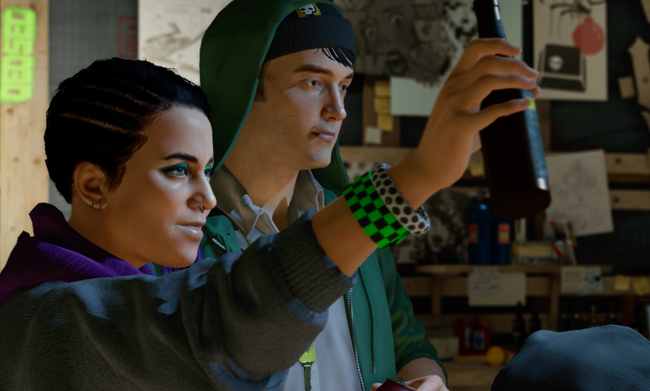
The biggest lesson Watch Dogs 2 learned from its predecessor is that we’re a bit tired of mopey, edgy videogame protagonists, which Aiden Pearce embodied completely. This time around, Marcus and his support cast in the hacker collective DedSec are likable, funny people, and it’s good to see a black lead in a big-budget game, where people of color are so often relegated to supporting roles. Marcus and his friends are upbeat and know how to laugh, and their energy goes a long way in making the worst parts of Watch Dogs 2 tolerable. I didn’t feel like I was best friends with the DedSec crew, but they were nice faces to return to after every mission. They’d clap me on the back, high five one another, toss some beers around, and get to planning the next attempt to stick it to The Man.
Why-fi
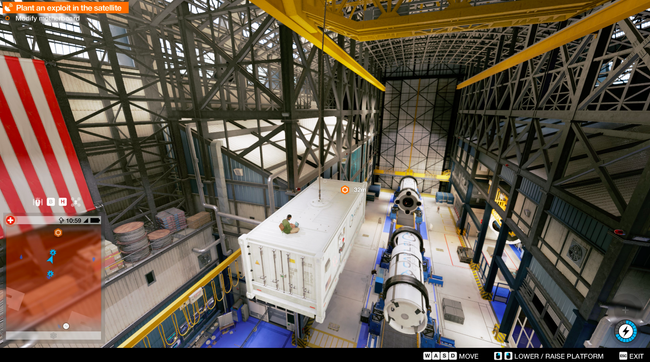
Stick it to The Man we did, over and over again. The main missions typically task Marcus with extracting or sabotaging data from a heavily guarded building, most often an obvious stand-in for the known Silicon Valley giants (Google is Nudle, for instance). Simple AI guards patrol the arenas, and using two new RC drones—one wheeled and the other airborne—you can scout out the area, marking enemies and interactive tech.
Because you have hacker smarts, you’re able to use drones, security cameras, or Marcus to interface with CTOS, an operating system embedded into city infrastructure, which means you can remotely influence anything connected to the system, like traffic lights, robots, and those handy explosive pipes, just by looking at them and pressing a button. For instance, when you’re trying to climb a building to get a clear vantage point to hack a massive construction crane, you can rotate it and lower the platform on the end to scale the tallest buildings in the city. Drive a motorcycle onto that thing and take it off the highest point as an attempt to infiltrate a few outdoor enemy bases. It didn’t work for me, but I laughed at lot, and it was more interesting than shocking guards with circuit boxes or calling in mob hits to murder them all. The life of a hacker.
To truly be stealthy, you’ll spend a lot of time controlling your drones. Snaking around most spaces are ventilation shafts just big enough for a small RC robot to roll through, but there’s never a sense I’m being stealthy or subverting the enemy threat when using vents. I’m infiltrating through the same obvious path that everyone else will, just going through the motions so I know where my objective is and where all the guards are. There’s no tension in mapping out an arena with drones since everything is always in its designed place. It’s busywork.
There were entire floors I’d scout with a drone, sneaking by unseen to download classified files or plant a virus, only to find that Marcus’ physical presence was required to tap some keys in the end. And so I’d essentially replay the whole level, but as Marcus, who is easily spotted unless he’s ‘in cover,’ meaning I’ve pushed him against a wall. I moved through the same rooms, the same guard paths, and to the same objective only to die from getting caught by a guard whose red outline was barely visible against a visually busy scene. Then it’s back to square one, scouting and setting up with the drone again.
If you do get spotted, Marcus’ toolset swings in a different direction with no impact on character. At your HQ, you can 3D print a complete arsenal, everything from a shotgun to a grenade launcher. It’s strange that lethal weapons are included at all, given the peaceful ends DedSec is shooting for, and Marcus doesn’t seem the type to murder. Shooting your way out of a situation isn’t much fun either. The cover system is serviceable, but with enemies that like to make a beeline for your position and no dodge roll to dance around them with, there isn’t much you can do once you’re flanked except run and shoot. Marcus is soft too, so it’s easy to get overwhelmed and torn up from any distance. Together, the hacking abilities are too passive to be as playful as Saints Row 4’s superhero sandbox and the shooting feels dated in comparison to GTA 5, which is over three years old. Without many ways to stack abilities or exploit the world and enemy AI beyond bullets and electrocution, Watch Dogs 2 is suspended somewhere in the middle, and gets tired over the course of 30-plus hours of play.
I left my # in San Francisco
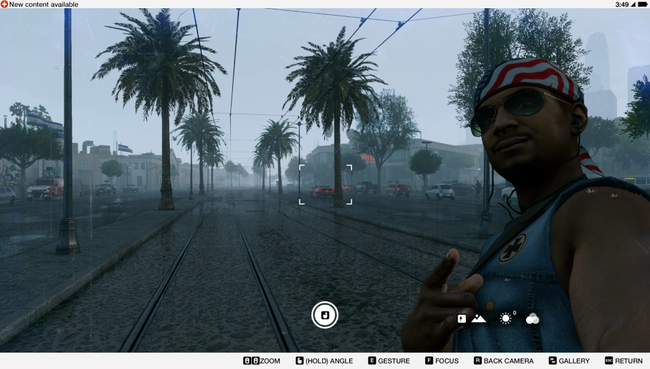
Watch Dogs 2 is not a short game. It’s bloated in the same way Ubisoft open worlds tend to be, with a massive list of side missions. Some are fairly involved and funny—in one, you hack Ubisoft’s office to leak a trailer for an unreleased game—but most want you to climb a building to tag a billboard or hack a CTOS service box for a quick scene that pokes fun at Silicon Valley bigwigs. There’s a whole series of mundane missions where you just hack ATM machines and mess with terrible people trying to withdraw money, which I’d be into if it wasn’t the same joke told six times via what amounts to a fetch quest. You can race your drones, drive San Franciscans around in a Crazy Taxi-esque series of challenges, and take selfies near famous landmarks to gain followers and upgrade your hacking skills. There’s a glut of stuff to do in the side missions, but none of it is particularly focused or exciting.
NPCs scream to one another about how good wine is over the familiar clank and whoosh of the city’s signature cable cars, just like the real thing.
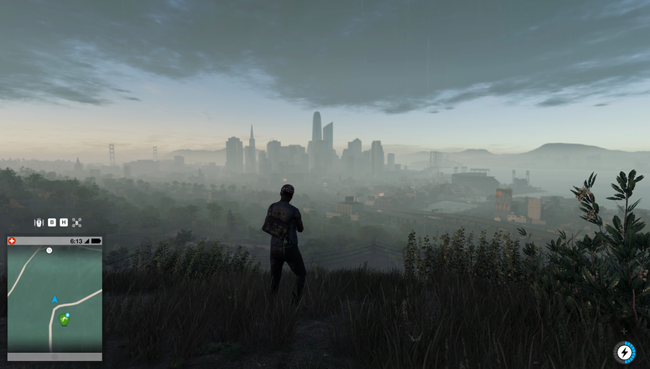
As mundane as the main missions can feel, they at least take place in one of my favorite open worlds in recent memory. Watch Dogs 2 is set in a scaled down recreation of the Bay Area, including San Francisco, Oakland, Palo Alto, and a small chunk of the Marin Headlands. San Francisco is the primary location, and it feels like a real place. NPCs scream to one another about how good wine is over the familiar clank and whoosh of the city’s signature cable cars, just like the real thing—without the omnipresent poop smell, that is.
Huge sections of the city are missing, and as such feels a bit misrepresentative for someone that lives there, but as a big mashup of the wealthy and tourist-heavy bits it works as satirical backdrop for an endless stream of Silicon Valley jabs and dick jokes (some pretty good ones, too). Even so, the parts it recreates are captured with eerie realism. I could intuit where such famous landmarks might be located, and found them just based on my sense of direction. Most striking are the vistas. Head up a hill in the evening for a beautiful and fairly accurate skyline.
Do it on a nice PC if you can. No short attention was given to the port, which features a huge selection of graphical options, including frilly features like a built in up scaling and down scaling tools that let you change pixel density independent of the window resolution and advanced shadow effects that make them blur the further they are from their caster. There are enough knobs and switches to make Watch Dogs 2 both run on an older rig without sacrificing too much detail, and push newer PCs to their breaking point. Further, the UI has been completely retooled to work with a keyboard and mouse. It doesn’t make driving as precise as it is with a controller, but I played the entire game that way without trouble. If you have a controller plugged in, you can seamlessly switch back and forth between them too. Each menu has a hotkey, and there are control options to tweak everything from steering sensitivity to how quickly the camera recenters on your vehicle after making a sharp turn. After the first game’s dodgy port, it’s clear Ubisoft didn’t want to repeat the same mistake.
Watch Dogs 2 never made me feel Hella Cyber, but when used to leverage as much chaos as possible in the open world, it can feel like playing GTA with a measured god mode enabled. Silly, strange things happen often, but only if you ignore the missions and mess around in the beautifully realized open world. That’s where Watch Dogs 2’s true enjoyment lies—not in its cheeky Hot Topic hacktivism story and frustrating, bland stealth scenarios, but in the nonsense you can pull off in a big sandbox with wacky toys and fast cars.
Far Cry Primal is a case study in how a game’s setting can drive its every layer, from the tone of its story, to the dangers of its world, to the brutality of its combat.
That setting is the Stone Age. It’s 10,000 BC, and our protagonist Takkar is searching for the lost members of his Wenja tribe. They’re scattered across the Oros Valley, a dense wilderness of forests, swamps, and frozen caves, complete with mammoths and sabertooth tigers. As Takkar, you’ll build up a new Wenja village with a multifarious cast of characters.
This reconstruction sets up Primal’s progression system. By recruiting the aforementioned Wenja–such as the shaman Tensay or the warrior Karoosh–you’ll unlock new items, weapons, and abilities. When you look past the facade, it’s essentially a new skin for the franchise’s traditional upgrade structure. But it lends character to what could be a lifeless system.
As you build up your tribe from within, you encounter members of other groups, the majority of whom have plans contrary to your own. The identity of each of the game’s three tribes, and the political dynamic between them, sets up conflicts in a natural way.
Building your village grants you new upgrades, equipment, and tools.
So too does Primal’s world. In fact, most of the game’s conflicts arise from nature. Primal still uses the basic open-world framework of a traditional Far Cry game, with a cascading series of outposts to capture, weapons to unlock, and upgrades to craft. But the Stone Age setting is far more foreboding than those of past Far Cry games.
Here, vicious animals travel in packs, striking as a collective whole while you slink through the undergrowth toward enemy camps. A day/night cycle also adds more tension to the world: predators are more abundant and aggressive in the darkness. Even now, after dozens of hours in this valley, I still feel anxious as the sun goes down, hoping I have enough animal fat to ignite my club and ward off hulking carnivores.
This focus on survival permeates Far Cry Primal. In the northern wastes, the cold becomes a factor, making each bonfire a glowing beacon of safety as you fight to stay warm. In Primal’s lush swampland, avoiding danger means avoiding the water, where underwater predators abound.
There’s a fine balance between tension and fun that elevates the whole experience.
As a solitary hunter with simple tools, you’re also less equipped to defend yourself than the protagonists of Far Cry 3 and 4. Gone are handguns and grenade launchers–here you have spears, clubs, and slingshots. They not only bring a slow, measured pace to combat, but also add to Primal’s overall identity and tone. You’re a lone wanderer here, not a walking armory. And although there are more ways to die in this Far Cry than any previous entry, Primal never feels too difficult–there’s a fine balance between tension and fun that elevates the whole experience.
On one of Primal’s nights, the valley’s lurking threats coalesced into a challenge that tested all of my knowledge of the game’s survival systems. I was out of wood for spears. I was low on meat for health. I was hundreds of meters from the warmth of the nearest campfire. So by sprinting toward the closest sanctuary on my map–collecting hardwood for torches along the way, and relying on stealth and my few remaining arrows for defense–I trekked through one of the more stressful scenarios the game had to offer. Yet it was thrilling. This was Primal at its best.
The Stone Age setting can also be a detriment, though. The simple toolset serves the game’s themes well, but with enough time, it becomes clear how limited your loadout really is. In stealth scenarios, I rely on my silent bow. In open combat, I swing my club wildly. When hunting elk and grizzly bears, I use my spears. There are several more creative tools, but by and large, I find myself relying on the same simplistic options time after time. Primal’s reliance on Stone Age combat detracts from the emergent scenarios that occur elsewhere.
Certain animals function better as stealth companions.
There are also powerful enemies whose excessive armor chips away at the fun. I had the best spear upgrades possible, but even at this point in the game’s late hours, these armored brutes can take almost 30 seconds to bring down. That’s not fun–that’s tedium.
But then there’s the Beast Master skill tree, and it’s the most impactful change to the Far Cry formula. It allows you to tame the creatures in this ancient setting, recruiting them to hunt, fight, and travel with you.
Jaguars kill enemies without alerting larger groups. Wolves pounce on distant archers while you close the gap. You can also ride bears and baby mammoths, clawing and bashing your way through groups of warriors with little resistance. You can use your owl to scout the land ahead of you, tagging more dangerous fighters and dropping makeshift grenades into groups of enemies.
Beast Master abilities are the embodiment of Far Cry Primal’s strengths.
Learning the unique abilities of each animal, and taking the time to experiment with them, is essential for your survival. After a while, your predator allies become an extension of yourself. They become the powerful weapons otherwise absent in the the abrasive wilderness.
These abilities are the embodiment of Primal’s strengths. When it uses the Stone Age setting to elevate the combat and reinforce the brutality of nature, it thrives. It fosters a give-and-take relationship with the wilderness, granting you the means to survive, but also the threats you have to overcome. That focus on primitive times can become a hindrance at certain points, with limited tools and repetitive combat, but in the end, Far Cry Primal stays true to its callous setting, fleshing out every layer of the captivating world it creates.
Editor’s Note: Far Cry Primal is now available on PC, and after taming numerous wild animals, liberating defended enemy outposts, and recruiting several members of the Wenja tribe, it’s clear that Primal’s PC version not only matches the quality of its console cousins, but slightly outpaces them in several ways, too. 60fps makes the brutal combat smoother. Detailed textures lend a more natural look to the Stone Age environment. Far Cry Primal’s setting is its greatest strength, and in its newest form on PC, it’s still worth the many hours it takes to explore.
We use cookies to ensure that we give you the best experience on our website. If you continue to use this site we will assume that you are happy with it.