In the earliest moments of Prey’s opening hour, I found myself trapped in my own apartment. The windows were sealed, the doors were locked, and the elevator in the hallway was broken. Eventually I figured out I could smash my way through a sliding glass door, but I later discovered there was another possible solution: I could have escaped through the fish tank.
Like Arkane Studio’s other major first-person action franchise, Dishonored, Prey equips players with versatile tools and abilities that can be used to solve problems in a variety of ways. However you choose to approach its puzzles and attack its enemies, the game endeavors to ensure you can actualize your ideas, even if that means smashing a decorative aquarium and crawling through the resulting hole. It’s a textbook example of the “player choice” approach to game design championed by classics like System Shock, Deus Ex, and, of course, Dishonored.
“If you help [survivors] out, they might show up in your office later and provide help. Or you might have an empty office, if you play that way.” — Ricardo Bare, Lead Designer
But Prey also apes specific elements from other acclaimed titles, including BioShock, Half-Life, and Dead Space. All told, the game contains traces of stealth, action, survival, role-playing, and even horror games, all set within a single sprawling space station that rewards exploration. I spent more than an hour playing from the beginning of the game and still came away feeling like I’d barely scratched the surface of Prey’s ambitions. And while I’m excited about what the game could become should it successfully realize all of its ideas, it’s not yet clear how or if its disparate parts will gel together–or even if they succeed individually.
Some of its mechanics boldly deviate from genre norms, but it’s too early to tell if this will ultimately prove refreshing or just confounding. For example, Prey contains firearms, but unlike the vast majority of modern shooters, you cannot aim down sights. Instead, the left trigger is reserved for optional alien powers unlocked later in the game. “Once players acquire Typhon abilities, the left trigger becomes the means by which those powers are targeted and activated,” explained lead designer Ricardo Bare following my demo. “Holding left trigger freezes time and allows players to aim powers [like] Kinetic Blast or pick targets as in Mimic Matter. It’s similar to entering VATS mode in Fallout.”
This ability-focused setup worked out fine for Dishonored, but guns seem more central to Prey’s design: I acquired a shotgun, pistol, and multipurpose GLOO Cannon within the first half hour. Despite this abundance of weapons, however, ammunition proved extremely scarce, and the grid-based inventory system limited the number of items I could carry. Though by no means as a punishing as a true survival game, I still had to scavenge for health and ammo while juggling crafting materials to make room for more immediately useful items. And there’s another catch: strenuous actions like sprinting and melee attacks drain your stamina meter, which is quick to deplete but slow to recharge (at least early on). When it’s empty, you can no longer attack, and your movement slows considerably.
Your health won’t regenerate on its own, but you can drink from fountains or seek out healing items to restore it. Or you could just load a quick-save and try again.
Altogether, design choices like the stamina bar, aiming, and survival mechanics constitute a gamble, and while I still can’t quite decide if that gamble pays off, I am impressed Prey refuses to be bound by convention. And though its opening hour left me feeling a bit underpowered, the game does provide plenty of options for growth as you progress. Prey contains two completely separate upgrade systems–one for human abilities and one for alien abilities–both of which comprise three distinct branches that all focus different playstyles.
Bare remained reticent about the total number of possible upgrades, but he did confirm that, “just based on the economy alone, you can’t acquire enough ‘neuromods’ to get every single power. You’d have to start a new playthrough. You could probably acquire enough to fully spec out all the alien abilities or fully spec out all the human ones, but not both.” Neuromods are collectible items scattered throughout the space station that allow you to unlock new powers for protagonist Morgan Yu. Sadly, none of the alien abilities were available during my demo (I couldn’t even find them in the menu), but I did scrape together neuromods to start exploring the human upgrades.
For the most part, the human powers provide simple but helpful boosts that unlock new options within the world. You can bump up Morgan’s strength, for example, which then allows you to move heavy objects and access rooms that were previously blocked. You can also improve Morgan’s hacking abilities, which you can use to open doors, decrypt passwords, and uncover hidden safe codes. You can even select a repair skill that lets you fix busted elevators and revive sentient turrets much like the ones you found back in BioShock.
It’s disappointing the more exotic alien powers largely remain a mystery outside of the few already announced, like the ability to morph into certain physics objects. Regardless of what those powers turn out to be, however, Prey’s extensive skill trees should support a variety of playstyles. When asked about stealth options, for example, Bare replied, “You don’t have to fight. There’s maybe a couple of instances in the game where you absolutely have to fight something, but you can definitely play stealth. It’s fair to describe Dishonored as a stealth game; this is a game with stealth. It’s just one of the branches of upgrades you can apply to your character.”
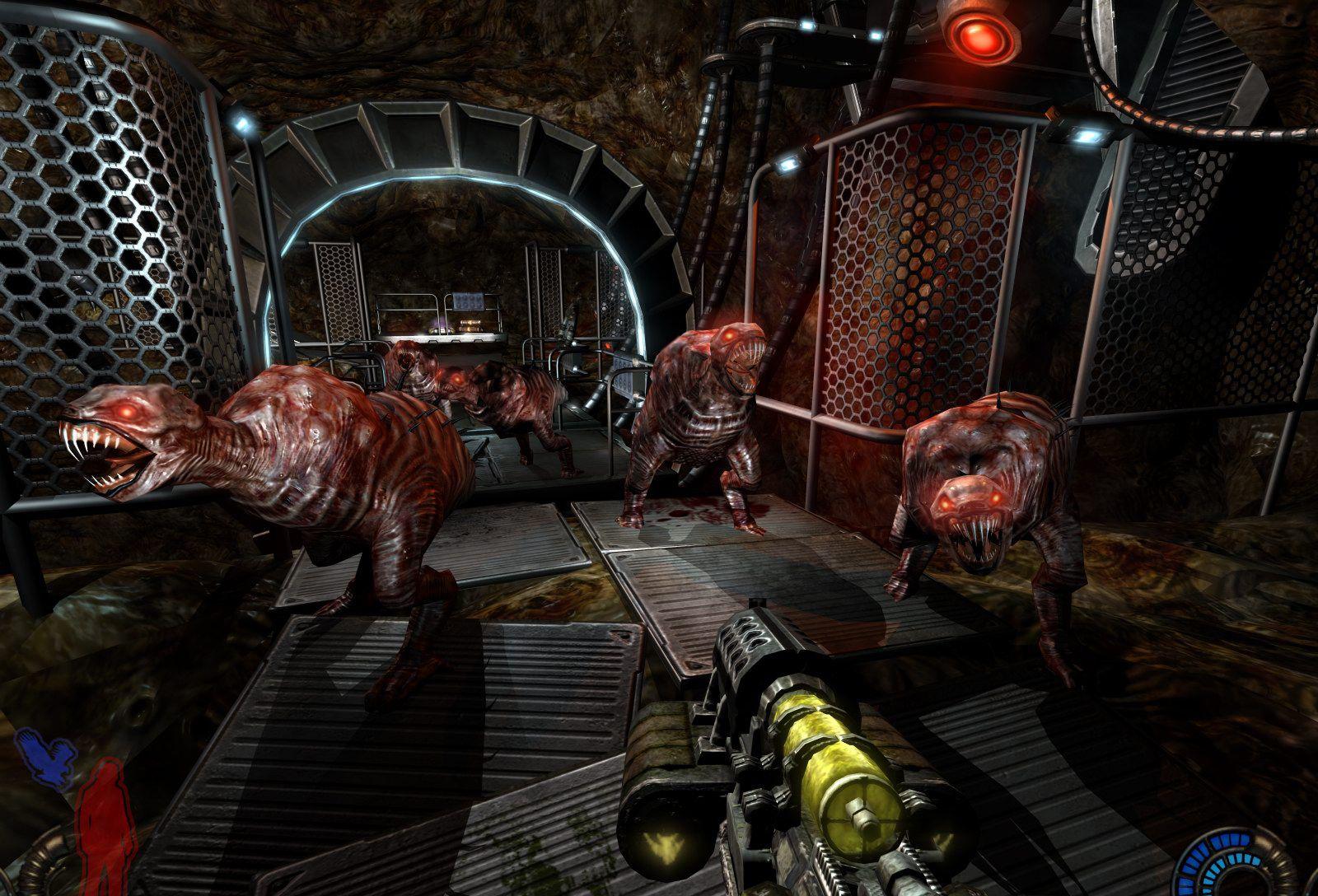
Thanks to Dishonored, we know Arkane does powers and playstyles well, so I’m anxious to see what’s still to come from Prey. In the meantime, the game already contains a few brilliant ideas, most notably its abundant Mimic enemies. Prey takes place on a space station in the grips of an unknown catastrophe, so it’s crawling with creepy, spider-like aliens. In groups, they’ll swarm you with a front frontal assault, but when you catch them alone, they may choose camouflage instead since Mimics can disguise themselves as any physics-based object in the game: chairs, trash cans, potted plants–you never know when something’s going to spring to life and try to rip out your throat.
To make matters worse, Mimics are indistinguishable from the objects they emulate–a Mimic disguised as a trash can will look identical to every other trash can. As a result, the random clutter we ignore in every other game suddenly becomes a source of constant suspicion, brilliantly turning our ingrained expectations against us. Even more impressively, Mimics pick objects procedurally, meaning if you die and reload an earlier save, there’s no guarantee you’ll find hidden Mimics in the same locations. And more than once during my demo, I chased a Mimic into a room only to find the room empty when I burst through the door, meaning the Mimic was smart enough to hide convincingly in the split second it was out of my sight. That’s both impressive and terrifying.
“A lot of the side missions serve to flesh out the space station,” Bare continued. “You can just hit the main beats and finish the main game, but you can spend many many many hours going down side trails, like finding missing people.” Unfortunately, I didn’t encounter any of these missing people during my demo, but they’re potentially one of the most interesting things about Talos 1–and Prey itself. According to Bare, “How you treat the human beings on the station matters. There are consequences throughout and at the end, especially for what you do with the survivors that you meet. There are definitely multiple endings–a wide variance. There’s two main branches, mostly centered around the fate of the space station and the survivors, but then within those branches, there’s tons of little permutations.”
I’m not going to spoil it here, but Prey’s superb Portal 2-esque opening sows the seeds of paranoia that will no doubt take root as you dig deeper into the story. And while Bare assured me that storytelling is “not our key drive” and that the game won’t “have a bazillion cutscenes,” the idea of branching endings is still incredibly intriguing given the conspiratorial nature of the intro. Regardless of how the narrative plays out, however, Prey’s ambitious blend of genres combined with its open-ended exploration and emphasis on player creativity made my demo an unusual yet remarkable experience. With any luck, the final game will synthesize these ideas into a cohesive package worthy of Arkane’s reputation.
Prey is scheduled to launch on PS4, Xbox One, and PC on May 5.
There’s always been something voyeuristic about sniping in video games. With a powerful rifle in hand, you’re perched in some bombed-out tower overlooking a Nazi-occupied town, your crosshairs fixated squarely on the head of an enemy soldier as he strides along his designated patrol route. He has no idea that with one pull of the trigger, you’re about to send a bullet careening through flesh and bone, snuffing out his young life in a single, gory instant. It’s in these moments, when an unaware enemy is trained in your sights and you take a deep breath before pulling the trigger on a skull-shattering killshot, that make Rebellion’s Sniper Elite such a devilish joy. Where the series has regularly faltered, however, is in the moments between these euphoric, long-range kills, where it has often been a cumbersome chore just to get around in a stealthy manner. With Sniper Elite 4, Rebellion has changed all that.
This starts with the levels themselves. In Sniper Elite 3, Rebellion abandoned the linearity of previous series entries in favour of opening things up, and Sniper Elite 4 continues that trend in grand fashion. The smallest map in Sniper Elite 4 is three times the size of the largest one seen in its predecessor, and these expansive sandboxes are brimming with open-ended objectives you can choose to complete in any way you desire and in any order you please. They’re varied locales, too, stretching across picturesque Italian landscapes on the verge of invasion: from the sunswept isolation of a cavernous island off the coast, to the narrow confines of an opulent beachfront town, to the dense overgrowth found in the heart of a verdant forest. Each one teeming with fascists just waiting to be extinguished with a well-placed bullet.
And these massive playgrounds aren’t just big for the sake of it; they grease the cogs of every other aspect of Sniper Elite 4’s design. Collectibles and advantageous sniping positions are judiciously dotted around each map, encouraging you to explore, and the macabre satisfaction of sniping is increased tenfold when you’re able to execute a pinpoint headshot from as far as 400 metres away. Sniper Elite’s signature X-ray kills return in all their morbid glory here–now with even more detail–and it’s a particular treat to see a bullet travel over these extensive distances before colliding with an enemy’s skull, the hot lead bursting through eyeballs and sending a mixture of brain matter and skull fragments scattering onto the floor. This may sound tasteless, but the series’ grisly ballistics are still second to none–and there’s something wonderfully schlocky about rupturing an enemy’s scrotum from 200 metres away.
Getting into these fruitful sniping positions isn’t the chore it once was either. There’s a newfound responsiveness to protagonist Karl Fairburne’s movement that makes it easier to get around and stay hidden. This polishing of the underlying mechanics makes tiptoeing across these mammoth spaces enjoyable in itself. There’s a decent degree of verticality to each map, too, and you now have the ability to utilize it by clambering up specific surfaces, jumping across gaps, and climbing in and out of windows to navigate with increased freedom–not to mention the ability to wipe out a few enemies with some stealthy ledge takedowns. Environmental kills also play a part, whether it’s a convenient red barrell or a rickety-looking bridge, and foliage is often a welcome aid to keep you out of sight from curious Nazi eyes.
With the structure (or lack thereof) of its open-ended mission design, there’s also a clear emphasis on experimentation. This is never more evident than with the two-pronged function of each item in your deep-pocketed arsenal. For distraction devices, this means you can switch between throwing rocks to lure enemies to a specific area, or a whistle that will bring them straight to you. Where it really gets fun, however, is with the bevy of explosives in your stockpile. Equip landmine, for example, and you can set it to detonate after one press or two. The former will see it explode the moment it’s stood on, which is ideal for a single enemy; while the latter detonates after two steps, making it perfect for dealing with groups. Rig one up with two presses in, say, a doorway, and the delayed blast radius is liable to take out three or four enemies, rather than just the first guy to enter the room. Once you start booby trapping bodies, this devious feature really comes into its own.
Personally, I have a soft spot for the sniper rifle’s secondary function: suppressed rounds. These trade dramatic bullet drop-off for silent sniper fire, giving you the flexibility to use the game’s standout feature with much more frequency. This was actually an issue in Sniper Elite 3, where it often felt like there were too few chances to use the sniper rifle without alerting everyone to your position, almost encouraging you to stick with the silenced pistol. There are still opportunities to mask the loud crack of your rifle with malfunctioning generators or the thundering noise of Luftwaffe flying overhead, which is the ideal way to silently pop skulls. But in areas where this isn’t always possible, you now have the option to snipe with far more regularity, which is key in a game built around doing just that.
If you are spotted and the bullets start flying, pulling out your Thompson and going toe-to-toe with the bloodthirsty fascists isn’t as clunky or frustrating as it has been previously. There’s a fluidity to the way the game shifts from stealth to action and then back again. And while its cover-based shooting is merely competent at best, its viability as a messy plan B for when things go awry is very much appreciated–which, once again, traces back to the size of the levels themselves. Every objective essentially occupies a pocket of space on these vast maps. Once you’re inside one of these pockets, you can cause as much mayhem and destruction as you please, and the rest of the enemies dotted across the level will be none the wiser. This allows you to go in all guns blazing and savour each violent moment, safe in the knowledge that you won’t have to worry about the rest of the mission being full of Nazis on high alert. It’s a smart choice.
The AI shows a marked improvement over its predecessors in situations similar to this. They’ll attempt to triangulate your position based on the sound of gunfire, and officers will command their troops to overwhelm you if they have your location locked down. Inconsistency is a common menace, though, and they’re not always the brightest bunch. There were a number of occasions where I would simply circle around an area after being spotted, only to find a bundle of enemies cowering behind cover near my last known position. With all of their backs turned, it was easy pickings. In other instances I’ve killed an enemy whose body is quickly discovered by one of his buddies. Naturally, I kill him while he’s examining it, which garners the attention of another guard, and you can probably tell where I’m going with this. Guard after guard after guard; each one brazenly disregarding the growing pile of corpses to wade into my line of sight.
If you want a harder challenge from the occasional bungling enemy, the “Authentic” difficulty setting strips away all of the handy assists and extends the life of the campaign with a steep learning curve. You’ll probably want to skip all of the cutscenes a second time through, though. The plot is completely forgettable; a stereotypical World War II tale, with an unhinged Nazi villain, and a superweapon only our gruff American hero can stop. Some surface level details touch on the Italian resistance and the mafia’s role in the war, but it never delves deep enough to be particularly enlightening or engaging as a story. Beyond the beautiful Italian landscapes, the setting isn’t exploited as much as one might hope.
Sniper Elite 4 feels like a natural progression for this series, as Rebellion continues to refine its systems and put a greater emphasis on the long-range shooting
Multiplayer serves up a plethora of game modes spread across competitive and cooperative offerings. Control asks teams to battle for supremacy over an ever-moving control point, disregarding the sniper rifle in favour of some up-close-and-personal skirmishes. This sits in stark contrast to the rest of the competitive modes, which are predominantly marksman affairs. If you enjoy cautiously moving across maps with an eye open for the glint of an enemy scope, then there will be something here for you. I can’t say I’ve ever regularly enjoyed sniping in multiplayer shooters, so entire matches based around this style of combat aren’t for me. Killing a human player from the opposite side of a map is still immensely satisfying, but these moments are so few and far between, it was never enough to hold my attention for too long.
Survival fares much better, as up to four players work together to withstand increasingly challenging waves of enemies– à la Horde mode. As snipers, distance is a key advantage, and it’s fun finding an opportune location to seek shelter and pick off each wave of progressively difficult Nazis. In a unique twist, the supply box you use to replenish your ammunition also moves to a different location every few waves, forcing you to get creative with your trap placement, and discover new areas to camp out. Once mortar fire, tanks, and heavily-armoured units rain down upon you, it can get incredibly tense.
Sniper Elite 4 feels like a natural progression for this series, as Rebellion continues to refine its systems and put a greater emphasis on the long-range shooting it does so well. Its stealth and action mechanics may be simplistic, but they’re functional and regularly enjoyable. And the maps–with their impressive scale, open-ended objectives, and clever level design–coalesce these disparate systems into a creative and fulfilling whole. There are still some issues with AI inconsistency, a bland story, and some dull competitive multiplayer, but it finally feels like this series is living up to its long-standing potential.
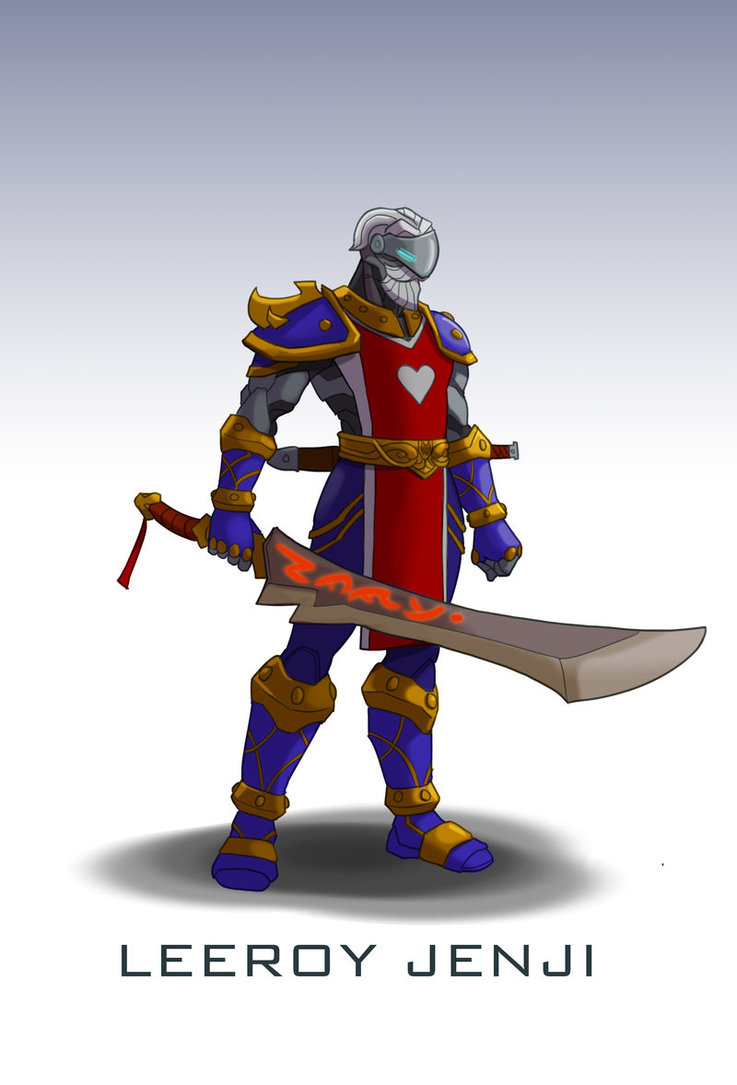
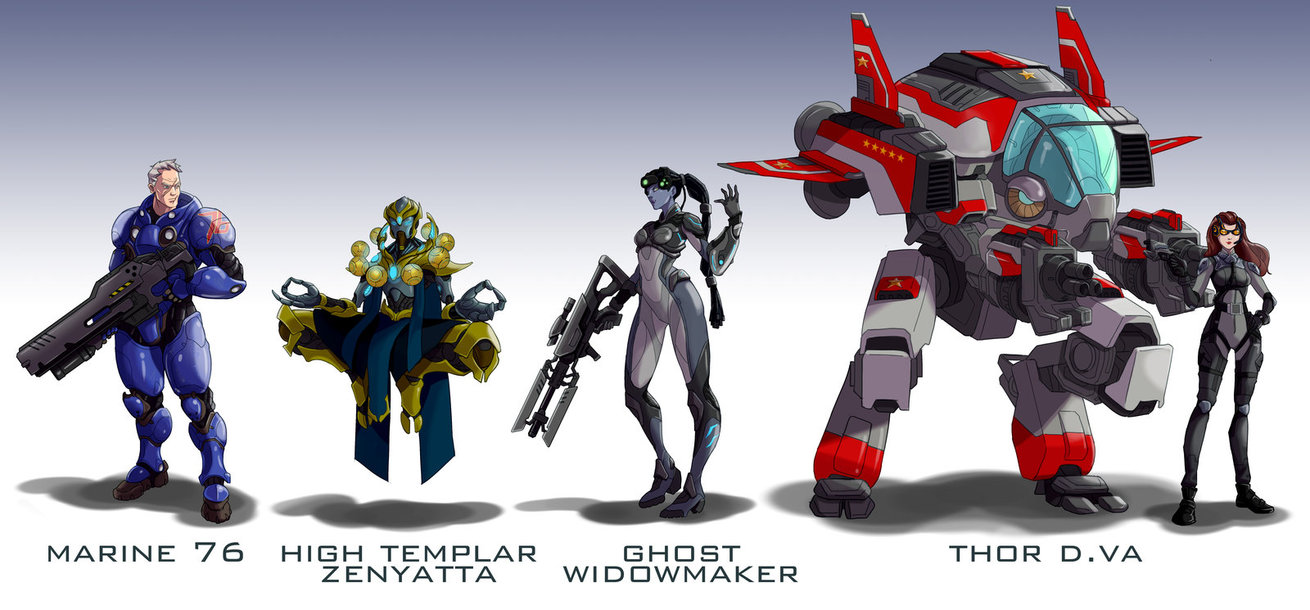
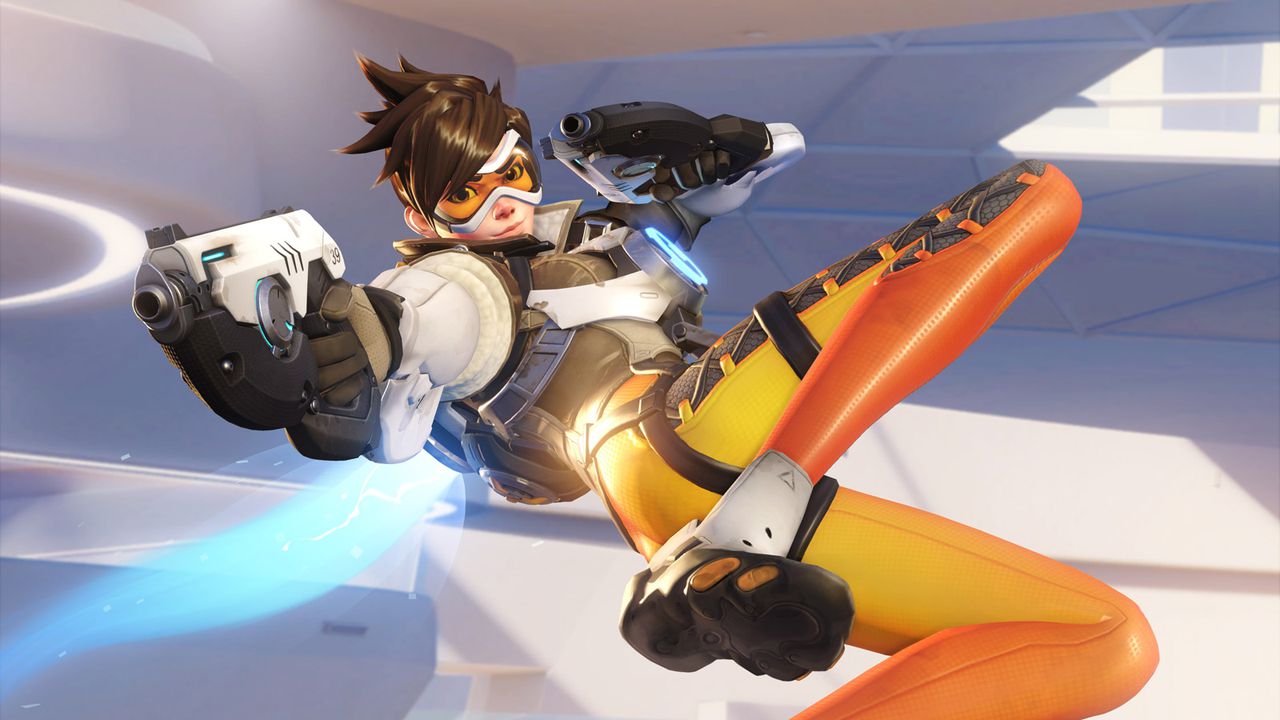
With just about every Blizzard hero appearing in Heroes of the Storm, it’s surprising Blizzard games haven’t cross-pollinated into Overwatch yet. Fortunately, artist Wildcard24 has rectified this oversight with these incredible takes on what Warcraft, Starcraft, or Diablo-themed costumes might look like in Overwatch. Spoiler alert: They look awesome.
As PC Gamer’s resident WoW fanatic, I’m in love with these Warcraft-themed outfits because of how well they blend the personality of both the character and the inspiration for the skin. Pandaren Mei seems like such a painfully obvious matchup that I’m a bit choked we haven’t seen official versions of these skins already.
For anyone who is sick of seeing a skull where your Genji teammate was moments after rushing the enemy team alone, Wildcard24 has an extra special treat: Leeroy Jenji.
Things only get better with Wildcard24’s interpretation of what Diablo and Starcraft-themed skins might look like. It’s almost a bit weird seeing how well Overwatch’s roster adapt to these other iconic characters. It might sound crazy, but it’s almost like they were all designed by the same company. Spooky.
Be sure to check Wildcard24’s DeviantArt profile for more of their work.
Blizzard says the drop rate during recent events was identical to that of previous ones.
While some players have suspected that a change had been made to the drop rate of Overwatch’s more desirable items, Blizzard insists that isn’t the case.
During the recent Lunar New Year event, some players found themselves without any new skins, prompting them to wonder if drop rates for rare skins had been lowered. Overwatch director Jeff Kaplan chimed in on Blizzard’s forums to say nothing has changed.
“The drop rates for Summer Games, Halloween Terror, Winter Wonderland, and Year of the Rooster are all the same,” he wrote.
During the Winter Wonderland event, some players complained not about drop rates, but the quality of higher-rarity skins. Specifically, players were upset that Mei’s new Legendary–the highest rarity level–wasn’t worthy of that designation. Kaplan apologized and said Blizzard would take that feedback into account.
With the Lunar New Year event having only just wrapped up, Blizzard hasn’t yet announced what the next big update will be. Some important balance changes have been introduced on test servers recently, while the developer is also testing out custom games and a server browser. In terms of content, rumors continue to swirl that Doomfist will be the next playable character–and Terry Crews is adamant that he gets to voice him.
True to Fumito Ueda’s work on Ico and Shadow of the Colossus, The Last Guardian is a fascinating game that portrays a heartfelt relationship between two unlikely cohorts–a nameless boy and a giant creature named Trico–who develop mutual trust, communication, and compassion against seemingly impossible odds.
Their tale is a shining example of storytelling through subtle cues and shared experiences; the occasional annoyances that come from trying to force members of two different species to cooperate are part and parcel of their partnership, for better and for worse. But touching moments throughout and an unshakable final act melt these grievances away. The culmination of your incredible journey crystallizes a bond with Trico and makes you immediately long for another adventure with your newfound best friend.
It all begins when you awake from a dream to find yourself imprisoned in a mysterious cave. Trico is nearby, subdued by a metal collar, armor, and a pair of spears lodged in its back. Though the cause remains a mystery until the end, you immediately understand the need to remove the weapons and forge an escape. Trico knocks you unconscious after you extract the first spear, but your continued efforts after you wake payoff. In short order, the creature is free from the heavy shackles, and the two of you begin your tricky escape.
You and Trico are instrumental to each other’s progress; it’s easy for you to slip through small passageways and precisely manipulate objects to activate doors, but only Trico can leap dozens of feet into the air and reach high, out-of-the-way places. Your massive companion needs to be coaxed into giving you a hand at first, and food in the form of glowing barrels works as a motivator at times, but you otherwise need to provide directions through physical positioning and vocal commands. Because you move with palpable inertia, running around in search of the next step and managing Trico at the same time can feel taxing, but its a small price to pay for the organic, lifelike animations on display.
Success typically comes down to identifying the one object or passage in an environment that allows you to move ahead, and working with Trico to access it. You will climb on the beast’s back to reach high ledges, use its tail to descend into pits, and lure it to jump into pools of water so you can ride the resulting wave. But you must accept its slow reaction times and patiently decipher its body language, and it’s a process that can test your patience when you’ve lost your path, dense as the world is with red herrings like intrusive outcrops and heavily ornamented architecture.
Yet even at its most disobedient, Trico is an impressive animal to behold, with the mannerisms of a house cat as it rests and slinks through environments, and the temperament of a lion during run-ins with possessed sentinels. Trico will swat and sniff curiosities–sometimes as a hint, other times because it’s simply distracted, and the only way to calm your companion after a fight or a scare is through the solace of petting and coos. When you look into Trico’s curious eyes as you run out of reach to pull a lever, or when it senses something frightening, you don’t see the artifice that defines most video game characters; you see an honest portrayal.
Much like a real pet, Trico doesn’t automatically learn because you want it to, but its progress yields confidence in your cooperation as it eventually learns to take commands on the first try. This is gratifying from a gameplay perspective, since you feel less like you’re wasting time investigating the world and more like you’re working in concert with a reliable partner. As an emotionally invested player, your patience is handsomely rewarded by the formation of an unwavering bond.
The Last Guardian is, for the most part, a totally convincing experience that draws you into the mindset of Trico and the boy. However, there are times when you’re reminded of the game they live in. From beginning to end, without an option to disable it, a button prompt appears when you’re in front of an interactive object. Contrasted with environments that force you to consider every option, it’s confusing that the game never trusts you to handle basic tasks and instead opts to interrupt the otherwise complex experience.
And despite handling numerous impressive scenes without a hitch, there are a few scenes with obvious frame-rate issues. These occurrences by no means dominate the game–far from it–but they make you consider the technological lattice holding the world together when they appear. It also makes you consider the impossible task Ueda and company likely faced when The Last Guardian was in development for PlayStation 3.
The resulting shift to PlayStation 4 has obviously paid off–troubled moments aside, your journey is dominated by awe-inspiring architecture and natural wonder. As you weave in and out of caves and ruins, you’re treated to wide views of towers and bridges in the distance that you may never visit, but they live on in your imagination as you piece together the story and world around you.
It isn’t clear whether or not The Last Guardian means to be frustrating at times–if it’s a concerted effort to test your patience for a lovable-yet-stubborn creature. Your affection for Trico and sympathy for both characters blossom nonetheless, culminating in an enrapturing series of revelations that cements your attachment to their personalities. Trico is the undeniable star of the show, exhibiting believable physicality and emotional range, but the boy is a valuable lesson in how to be patient and resilient when faced with unforeseen challenges.
When the book closes on their story, it’s hard not to open it up again and begin anew. The trials you overcome endear you to both characters, but the emotions Trico elicits make you want to give it another chance–to be the patient, effective partner it truly deserves.
PS3 owners can grab Anna – Extended Edition and Starwhal, while Ninja Senki DX and TorqueL are available for PlayStation Vita.
February’s PS Plus games should arrive when the PlayStation Store updates for the first time in February, next Tuesday, February 7.
While you wait, be sure to grab January 2017’s free PS Plus games now before they return to their normal prices. You can also take advantage of the latest PSN weekly deals, which include offers on Rise of the Tomb Raider, Grand Theft Auto V, and Dragon Ball Xenoverse 2, among others.
We use cookies to ensure that we give you the best experience on our website. If you continue to use this site we will assume that you are happy with it.