When shopping for a refrigerator, what are some of the first things you look for? Perhaps it’s ample freezer space or shelves that gracefully fit gallons of milk and a stack of leftovers. Maybe you even look for a proper crisper drawer that excels at preserving your food. Certainly, these are all valuable features to keep in mind while shopping, but would you ever consider buying a fridge with a built-in, 21.5-inch tablet on the front of it?
Samsung is hoping the answer to this question is a resounding yes, considering its recently released Family Hub refrigerator boasts this very innovative (and over-the-top) feature. So, while it still operates like a traditional refrigerator, the fact that it also has an integrated touchscreen controller firmly plants this beast in rarified territory. But is its inclusion of the tablet a little too outrageous? While some may be quick to say yes, we took the Family Hub for a spin over the course of a few weeks at our Digital Trends headquarters to determine if Samsung’s latest model is indeed the wave of the future or too smart for its own good.
The future of refrigerator tech has arrived
To create the Family Hub, Samsung took its Four-Door Flex refrigerator and added not only the 21.5-inch touchscreen to the top right door but also cameras inside. The Four-Door Flex is already a bit unique, because it has one compartment that can either be a fridge or a freezer, depending on how you set it. With 27.9 cubic feet of capacity, it’s a big, black stainless steel beauty.
What’s in a touchscreen?
To be honest, when Samsung announced its Family Hub refrigerator and promised to send one our way for review, we were skeptical. What could possibly be the point of installing a massive touchscreen onto a refrigerator? Nevertheless, as stewards of honest appliance reviews, we kept an open mind. Not only is a touchscreen an ambitiously innovative addition to Samsung’s high-quality line of refrigerators, but it doesn’t take long with the device to see its immense value. It’s not merely a mechanism for streaming music while you cook; it’s much, much more than that. Sure, it does stream music via Pandora and TuneIn but the sum of its parts makes it one incredibly valuable tool for families looking to stay organized.
Connect and serve
Granted, this doesn’t come without a few quibbles but before we jump into those, let’s talk about what it does. Obviously with a name like “Family Hub,” Samsung’s futuristic food chiller is geared toward keeping families in sync and connected. To accomplish this, the fridge lets owners upload and manage their daily calendars by way of an application called Sticki. Whether they choose to configure their schedule on the fridge itself, or by way of the app, everyone using the fridge has the ability to stay up-to-date with their daily routines. A clever add-on, no doubt, but our time with the fridge showed a desire to interact more often with the smartphone application than the fridge itself due in large part to the fact typing on the fridge is a bit clunky. Perhaps having spent years typing on a smartphone predisposes us to preferring a phone keyboard to a vertical touchscreen, but doing anything more than creating a quick reminder felt like a chore.
To a further extent, there are far more efficient calendar apps than Sticki, though a centralized calendar is certainly a step in the right direction for Samsung. Merely having the ability to easily share calendars, post photos, or write notes from the application (which then shows up on the fridge) is an incredible way for a family to stay connected. Additionally, having access to stored grocery lists and snapshots of what’s actually inside the fridge make the Family Hub’s suite of apps even more useful.
Outside of Sticki, Samsung’s Family Hub also provides users with the ability to build shopping lists; however, there doesn’t seem to be a way to send these to your smartphone at the moment. A great feature, sure, but it would be nice to have the ability to send these to yourself on your way to the store instead of being relegated to writing it down or snapping a photo of it with your phone. You could reasonably still send shopping lists via Sticki, though if Samsung wants to make a family’s life easier, having to access a separate app for one action is a bit unfavorable.
A window into its insides
You know what’s better than opening your fridge to see what’s inside? Clicking a button on the door to get a snapshot of its interior without having to budge the door whatsoever. By making use of three high-quality cameras secured to the inside edge of the Family Hub’s left door, Samsung has created a way for owners to get fresh images of the inside of their fridge every time they close it. Furthermore, an innovative tagging system allows anyone to attach, for instance, a “5 Days” tag to a carton of milk to keep track of its expiration date. The downside? The tags don’t move if you move the carton. Nevertheless, this entire feature is still cutting edge in terms as far as refrigerator tech goes.
While this function performed admirably during our time with the Family Hub, it was the ability to access the images of the fridge’s interior via Samsung’s Smart Home Appliance app that really wowed us. From literally anywhere — though, most likely the grocery store — a simple load of the companion application allows for a quick view of what’s inside the fridge. No more “did we run out of milk?” questions or “are we sure we have the correct ingredients for tonight’s dinner?” Having access to the captured photos while on-the-go is as useful as it is innovative.
Odds and ends
Rounding out the touchscreen’s impressive slate of features is its compatibility with Pandora and TuneIn to stream music or radio stations, its inclusion of a full-featured web browser, along with the ability to leave handwritten notes on the tablet’s home screen via its Whiteboard application. Local weather access, Wi-Fi connectivity, and Bluetooth functionality are also standard fare with the Family Hub, though it’s worth pointing out the Bluetooth feature only works as a Bluetooth out function for its Pandora and TuneIn apps — i.e. you won’t be able to sync your phone with it.
The Family Hub also allows for TV mirroring with compatible Samsung TVs, so if you feel the need to catch up on Game of Thrones while cooking dinner, the Family Hub’s got your back. Unfortunately, we didn’t have a compatible Samsung TV in-house while reviewing it so we weren’t able to enjoy this (somewhat) useful feature. Still, having the ability to watch your favorite show, or simply have the news on in the background while you cook, is a welcome feature, even if it does feel a little odd.
Tech aside, how good is it at being a fridge?
The Family Hub excels at its ability to maintain a consistent temperature in its refrigerator, freezer, and patented FlexZone compartment. Furthermore, the appliance’s onboard touchscreen allows for easy customization of any of those three areas, as owners have the ability to set the fridge between 34 and 44 degrees Fahrenheit or the freezer between -8 and 5 degrees Fahrenheit. As for the FlexZone, this innovative fourth compartment features settings such as Meat/Fish, Cheese/Vegetables, White Wine, Soft Freeze, and Frozen, which allow for ultimate flexibility, turning the space behind the bottom right door into a fridge or freezer on command.
Cooler than the other side of the pillow
Boasting tech called Triple & Metal Cooling, Samsung took extra care in assuring the Family Hub correctly monitors its humidity to offer precise temperature readings at all times. To make sure this continues to be the case — even if someone leaves either of the doors open for an extended amount of time — the Family Hub features an intuitive temperature control panel which allows for quick adjustments of the fridge or freezer’s temperature, while also giving owners access to alter the Flex Zone.
During our time with the Family Hub, we wanted to see how quickly the fridge and freezer compartments have the ability to revert back to their normal temperature. To do this, we left the doors of the refrigerator and freezer open for roughly 15 minutes. After closing the door and being prompted of how much temperature was lost — 5 degrees Fahrenheit for the fridge and 6 degrees Fahrenheit for the freezer — we shut each door to see how long it took for the temperatures to right themselves.
What we found was that after losing around 5 degrees of temperature, the refrigerator took roughly 15 minutes to get back to its set temperature of 38 degrees. Concerning the freezer, we originally had it set to -8 degrees Fahrenheit and after it rose to -3 with the door open for 15 minutes, it took just 10 minutes to get the temperature back to normal. Perhaps the fact the freezer remains at a cooler temperature normally is the reason for it cooling down quicker but 10 and 15 minutes for the fridge and freezer to revert back to normal, respectively, isn’t all that bad.
A streamlined music downloader that puts all the tools you need in a single neat package
Don’t worry, the app is a lot less clunky than the name. Freemake’s music downloader is designed specifically for getting music from YouTube, and it automatically downloads MP3s in the highest possible quality – 320Kbps – if available. You can use it as a YouTube search engine, enabling you to find music from the comfort of your desktop without having to invoke your web browser, or you can paste a YouTube address into it to start a download.
There aren’t any fancy swarming features like you’ll find with torrent downloads, but as a cheap and cheerful way to get YouTube audio, Boom is hard to beat.
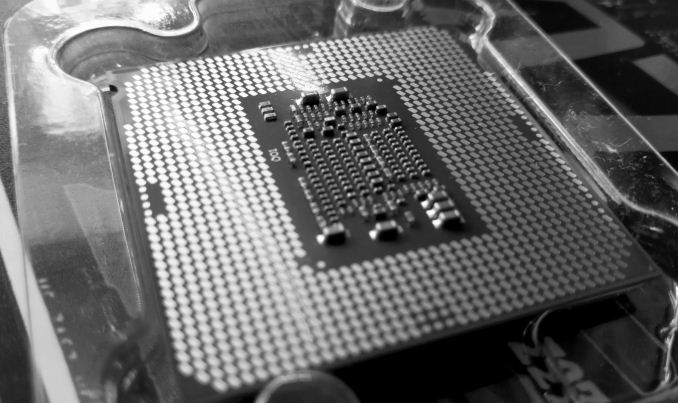
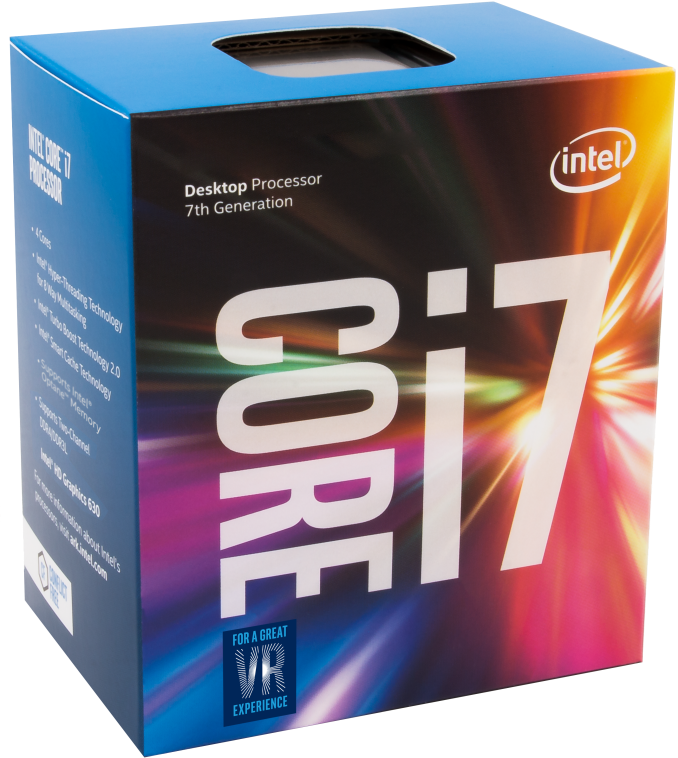
The i7-7700K, launched today, is Intel’s fastest ever consumer grade processor. Using Intel’s third set of processors at 14nm, using the new 14+ variant, we get processors with a better frequency / voltage curve that translates into more performance, better efficiency, and the potential to push the silicon further and harder. Here is our review.
Meet Kaby Lake, and 4.5 GHz Out-of-the-Box
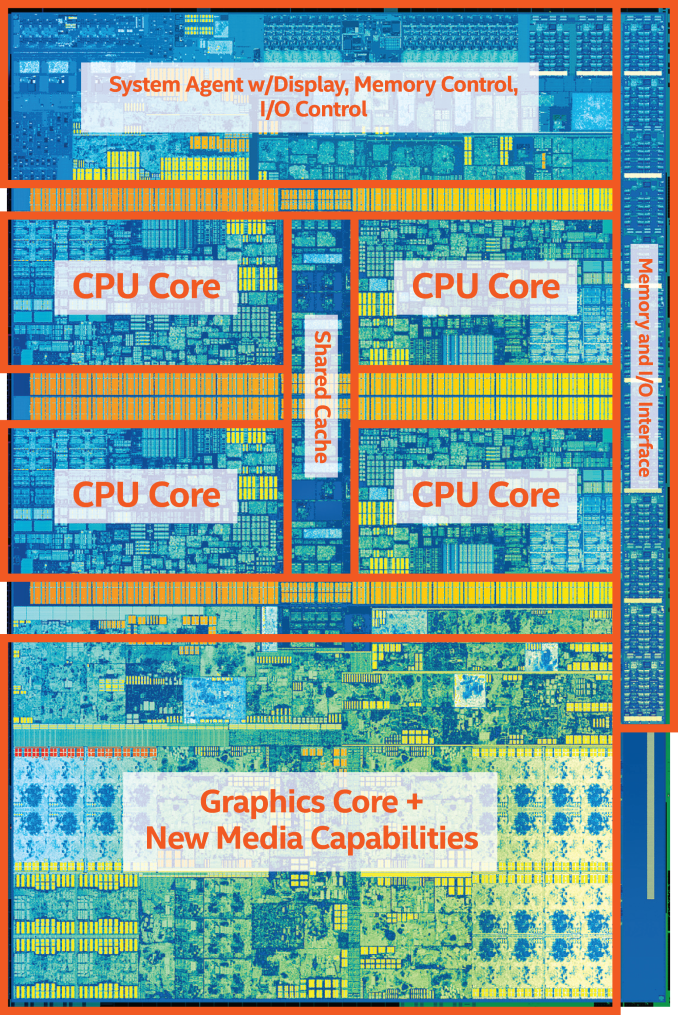
The i7-7700K is part of Intel’s 7th Generation of Core CPUs, which often goes by its internal code name ‘Kaby Lake’. The Kaby Lake family, as of today’s launch, stretches from 91W on the mainstream desktop down to 4.5W for notebook processors, all using the same underlying technology in different core and integrated graphics configurations. The i7-7700K is the top part of this processor family, featuring four cores with hyperthreading, a 4.2 GHz base frequency, a 4.5 GHz turbo frequency, a couple of new tricks and all for $303 list (so about $330 retail).
As a processor with the letter K in it, in Intel’s lingo this means the i7-7700K is an unlocked processor. Users with enough nous to understand the relationship between frequency, voltage, temperature and stability can take this processor above (or below) its standard operating frequency to get more performance without spending more money. The upshot of pushing the processor in this way is usually a higher power consumption, something that PC enthusiasts usually have to spare, and in the wrong hands a broken CPU through overclocking is worth the same as sand. There are two other K processors in the Kaby Lake family, the i5-7600K and the i3-7350K, which both have separate reviews as part of our launch coverage.
Intel Kaby Lake S SKUs
Cores/
Threads
Base/
Turbo
IGP
L3
eDRAM
TDP
Cost
i7-7700K
4/8
4.2/4.5
HD 630
8 MB
–
91 W
$305
i7-7700
4/8
3.6/4.2
HD 630
8 MB
–
65 W
$272
i7-7700T
4/8
2.9/3.8
HD 630
8 MB
–
35 W
$272
i5-7600K
4/4
3.8/4.2
HD 630
6 MB
–
91 W
$217
i5-7600
4/4
3.5/4.1
HD 630
6 MB
–
65 W
$199
i5-7600T
4/4
2.8/3.7
HD 630
6 MB
–
35 W
$199
i5-7500
4/4
3.4/3.8
HD 630
6 MB
–
65 W
$179
i5-7500T
4/4
2.7/3.3
HD 630
6 MB
–
35 W
$179
i5-7400
4/4
3.0/3.5
HD 630
6 MB
–
65 W
$170
i5-7400T
4/4
2.4/3.0
HD 630
6 MB
–
35 W
$170
i3-7350K
2/4
4.2
HD 630
4 MB
–
60 W
$157
i3-7320
2/4
4.1
HD 630
4 MB
–
51 W
$139
i3-7300
2/4
4.0
HD 630
4 MB
–
51 W
$129
i3-7300T
2/4
3.5
HD 630
4 MB
–
35 W
$129
i3-7100
2/4
3.9
HD 630
3 MB
–
51 W
$109
i3-7100T
2/4
3.4
HD 630
3 MB
–
35 W
$109
Intel calls the desktop like of processors the S series, and Kaby Lake-S (or KBL-S) ranges from a dual core low power 35W i3-7100T to the high-end 91W i7-7700K. The idea here is to offer many different parts at different price points to cater for customer needs, such as performance, power, cost and feature set. With every launch Intel tries to entice users to upgrade from their older system (citing hundreds of millions of daily PCs being 3+ years old), and so having new features is key to having better performance too.
With the high-end i7-7700K, being the top processor, the main draw is typically performance and overclockability. This review aims to take us through both of these, and the reasons why.
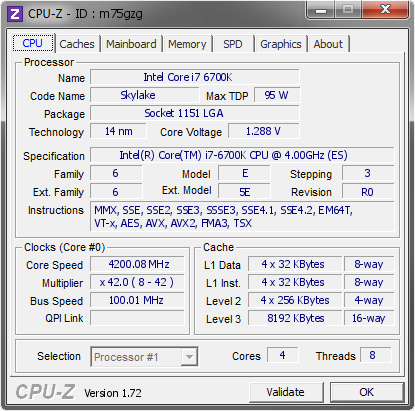
Comparing it to the previous generation high-end i7-6700K Skylake processor, we get the same configuration of cache hierarchy. The main difference between the two will be support for DDR4-2400 on the Kaby Lake rather than DDR4-2133, updated integrated graphics, a new generation of Speed Shift, AVX Offset support, and support for Intel’s ‘Optane Memory’.
Typically with each new generation of Intel CPUs brings about a fundamental increase in performance through the rate of instructions per cycle/clock (IPC) that the processor can go through. That being said, Intel has stated (and we’ve confirmed through testing) that Skylake and Kaby Lake are identical for IPC. As a result, the i7-7700K attempts to take the performance crown through frequency alone. The i7-6700K runs as 4.0 GHz base and 4.2 GHz turbo, while the i7-7700K runs at 4.2 GHz base and 4.5 GHz turbo. We quantify what this means in this review.
Speed Shift v2
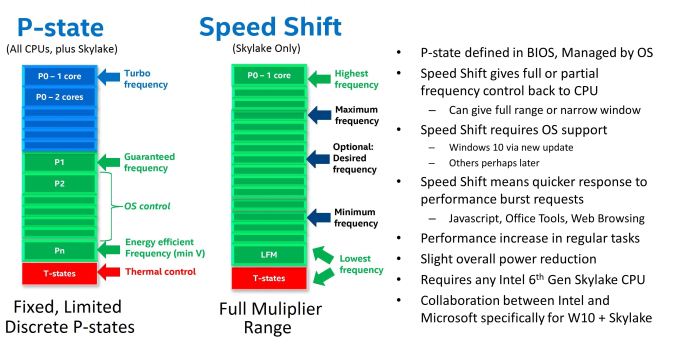
For the i7-6700K family, Skylake, Intel introduced Speed Shift (v1). This was a feature that, at a high level, gave control of the voltage/frequency curve from the operating system to the processor. Using a series of internal metrics, such as instruction analysis and frequency, the CPU would automatically adjust the voltage and frequency of the processor as required. This afforded two major benefits: one, with the CPU in control it has access to many more points on the curve compared to the OS which is limited to specific P-states on the processor.
The second benefit is the speed of transition. A processor that can ramp up to a high frequency quickly and then drop down as needed can get through instructions quicker but also save power. Imagine driving a car, and having to wait 60 seconds to change a gear – it’s that sort of analogy.
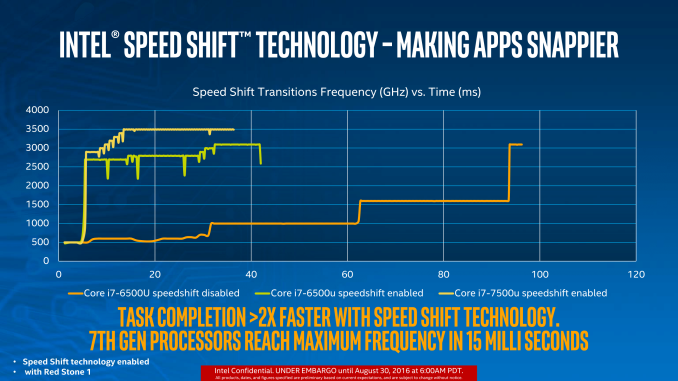
What Speed Shift v2 does in the i7-7700K and the Kaby Lake family, compared to v1 in Skylake, is manage those transitions to higher frequency faster. Before Speed Shift, transitions from idle to peak turbo were on the order of 100 milliseconds, and Speed Shift v1 took that to 30 milliseconds (with a good base established within 15). Speed Shift v2 means that peak performance from idle now happens in 10-15 milliseconds total. This means that interactions with the OS, such as touch, or actions that rely on low latency, can occur within a couple of frames on a 60 Hz display.
The benefit of Speed Shift lies a lot in touch devices, which perhaps doesn’t affect the i7-7700K in this review, but also in web interactions. A lot of web work is stop and start, such as scrolling or javascript functions.
There is one caveat however – Speed Shift currently only works in Windows 10. It requires a driver which is automatically in the OS (v2 doesn’t need a new driver, it’s more a hardware update), but this limitation does mean that Linux and macOS do not benefit from it. I would be hard pressed to not imagine that Apple and Intel were not working on a macOS driver, but as yet we have not had confirmation that one exists.
Optane Memory Support
The latest memory technology to hit prime time is Intel and Micron’s 3D XPoint. This is a non-volatile form of data storage that is bit addressable and can be used as DRAM or storage. Despite being at least a decade in the making, and being formally announced in 2014, it is still yet to show up commercially as it is still being developed. Intel plans to create 3D XPoint DRAM that is slightly slower than normal DRAM but both denser (more of it) and non-volatile (keeps the data after power loss, saves power altogether), as well as 3D XPoint Storage that is faster than standard NAND flash, and more configurable. It the scheme of things, we expect the storage based products to hit the market first.
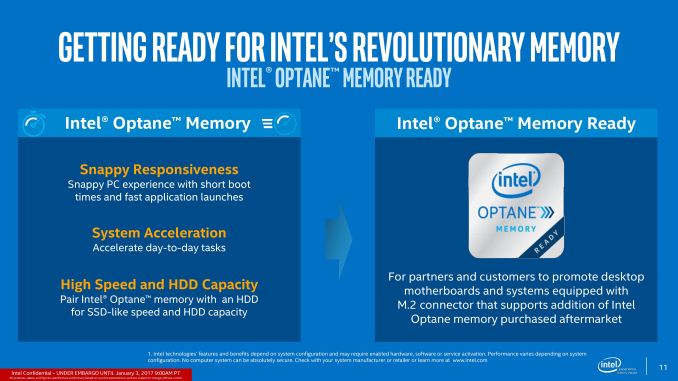
Intel, as far as we can tell, is set to release two main classes of product: Optane DRAM to be pin-compatible with DDR4 and require Optane DRAM enabled processors, and Optane SSDs which should work with any PCIe storage interface. ‘Optane Memory’ however, is something a little different. Based on pre-briefings, Optane Memory is certainly not Optane SSD we were told, but rather a storage cache for mechanical hard-drives. We’ve had this before with NAND flash drives, using Intel’s Rapid Storage Technology, and it seems that Kaby Lake and 200-series chipsets will support a new version of RST for PCIe-based storage. But because this is caching drive, such as the 16GB Optane Memory drives in Lenovo’s upcoming notebooks, and not Optane SSD, might lead us to believe that ‘Optane Memory’ drives are not designed to be directly user addressable.
All that being said, Intel has stated that Optane Memory standalone drives should hit the market nearer Q3 for general consumer use, which is more in-line with what we might expect to see with Optane SSDs in the enterprise space.
It’s hard to imagine anything less child-friendly than an uncensored internet. A rabid wolf, maybe, or a playground floored with broken glass and razor wire. The more connected we become the more we need everybody online – and that means trying to ensure that our children aren’t exposed to the very worst content, ideas and behaviour that exist online.
Software can’t do everything, of course, but it can help to make parents’ lives much easier. These are our picks of the best parental control tools.
Protect your kids on Windows, OS X and mobile devices with Qustodio’s free app
Qustodio
A full suite of parental control tools
Most parental control software is aimed at Windows, but Qustodio (think ‘custodian’) is also available for Mac, Android, iOS, Kindle and (weirdly) Nook.
The free version covers the basics, enabling you to set rules and time schedules, block pornography and other unsuitable content; if you go for the paid-for version that adds SMS monitoring, social media features and per-app controls. But even the free version is one of the most comprehensive parental control apps around.
Its raft of features and support for a wide range of platforms make Qustodio the best free parental control software, but there are some other excellent free programs available, some of which may be better suited to your individual needs as a parent. Read on for our top choices.
A lot is riding on the Nintendo Switch. The veteran game company, while still enjoying relative success in the handheld market despite the ubiquity of smartphones and tablets, really struggled to drum up interest in its last home gaming machine, the dual-screen Wii U.
Mixed marketing messaging and a lack of games meant the Wii U never got anywhere close to reaching its potential – let alone the lofty sales figures of its predecessor, the motion-focussed Wii.
So here we are gawping at an all-new Nintendo, that, while just as innovative (and arguably challenging) in its design as its predecessor, is being positioned as a far more mainstream device, one that Nintendo expects you to take with you practically everywhere.
But will you want to? Going on our first hands-on testing we can say the answer is a fairly comfortable “yes”, despite higher than expected pricing – provided that Nintendo can deliver a compelling online offering.
Design
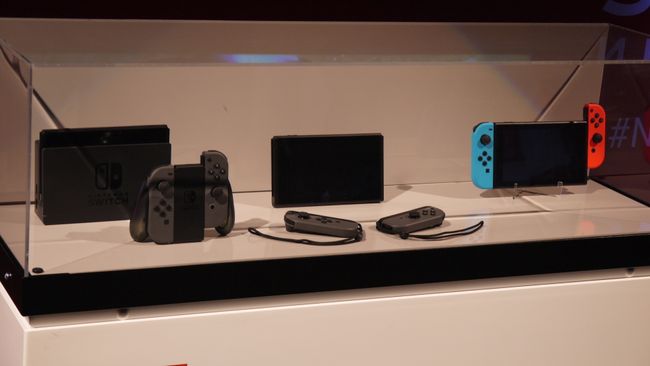
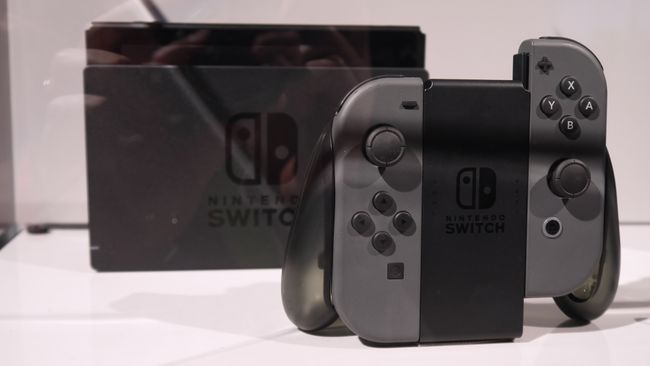
The Nintendo Switch is quite unlike any games console that’s ever come before it. In fine Nintendo tradition (if you can call the gaming equivalent of iconoclasm ‘tradition’), it’s done away with the concept of one fixed box sat under your telly with the Switch. Instead, it exists in two distinct states: firstly as a portable tablet device with a built-in kickstand, and secondly docked in a base that connects to your TV.
Paired with its breakaway, adaptable controllers it’s a bit like Nintendo’s answer to the Transformers, ready to be reconfigured depending on your current gaming need. Sat at home ready for a marathon session? Plug the tablet into the dock and beam your gameplay onto the big screen.
Sat on a train with a table in front of you and the Switch in your bag? Pop out the tablet unit’s kickstand, grab the nunchuck-like controller parts and get playing. Roaming a park? Plug the two controller sticks in either side of the screen and you can walk about and collect those Zelda rupees at the same time.
From the restrained core grey and black color scheme, as heavily displayed in pre-release marketing (blue and red Joy-Con controllers will also be available), to the choice to revert back to cartridges for play, it’s clear that Nintendo is subtly shifting its target audience. Sure, it’s not going to ditch its family-friendly appeal, but it knows it has to win over the older, so-called ‘hardcore’ gamer reared on a diet of sci-fi shooters.
So you’re left with an unassuming dock that would sit comfortably under a serious home cinema setup, and cartridges that are portable and sturdy, and which entertainingly trade on nostalgia – if hamstringing any chances of disc-based backwards compatibility.
The key idea uniting all these elements is that, essentially, wherever you are, however much time you have, you get the same great gaming experience, taking the home console fun that you enjoy wherever it’s most convenient for you to play.
Specs and performance
But how does that experience stack up against the competition? Has Nintendo managed, for the first time in decades, to get its hardware on a level footing with the PS4 and Xbox One competition? Though you can argue that the unique form factor negates such comparisons, the simple answer is “not quite”.
The Nintendo Switch is a solidly capable machine, but its internals appear far more power-efficiency focussed than geared towards pure processing grunt; certainly, at its first press event, there appear to be no games challenging the visual fidelity of Sony or Microsoft’s consoles. But that’s never really been the point of a Nintendo console, with the company far more concerned with innovative gameplay forms than photo-real visuals.
Under the hood of its core tablet unit you’ll find a custom Nvidia Tegra processor, broadly comparable to the Tegra X1 found in an Nvidia Shield TV. 32GB of storage space is onboard too (some of which is dedicated to the system software), along with 802.11.ac Wi-Fi.
The screen itself is, of course, a critical part of the equation – especially given how disappointing the Wii U’s comparable Gamepad proved to be. The Switch screen measures out at 6.2 inches, with a resolution of 720p.
It proves itself to be a very enjoyable screen to view. It has vibrant colors, a relatively sharp resolution, and is able to keep up with the breakneck nature of Mario Kart 8 Deluxe, which we had hands-on time with. It’s not as impressive as the top-end smartphone screens, but it feels dramatically better than what the Wii U Gamepad offered.
We weren’t able to try out the touchscreen capabilities of the screen at the event. Whether intentionally or not, the touchscreen appeared to have been disabled on most of the demos we tried.
Supporting Wi-Fi online play, up to eight Nintendo Switch consoles can link up for local multiplayer play, and when we used this to play Mario Kart there wasn’t any evidence of lag.
Battery life for on-the-go play is, of course, a concern. Nintendo quotes a very heartening six-plus hours of battery life when the Switch is disconnected from a USB-C power supply, although that’s very much dependant on the title being played – Nintendo admits, for instance, that you’ll get closer to three hours play when firing up The Legend of Zelda: Breath of the Wild when out and about.
We’ll have to take the Switch out into the real world to see if that claimed upper number holds up.
Docked vs portable play
So, how do the two core gaming experiences (untethered on-the-go versus docked at-home play) compare? So far, very favourably.
The Switch outputs to a TV at a resolution of 1080p, with 5.1 audio output offered. Considering the home console standard really remains at 1080p (with the exception of the adaptive-up-to-4K resolution of the PS4 Pro), that’s competitive. Charging from the dock, it doesn’t of course come with any battery power limitations.
Going on the few games available to play at the Nintendo press event, it seems that only the most demanding of players will notice a difference between docked and portable performance. On a 1080p television there were more jagged edges visible on the console, but frame-rate seemed un-impacted by form factor.
The docking and undocking process is as seamless as can be. We got a chance to try out Breath of the Wild in both configurations, and even switching mid-gameplay presented no trouble to the console – you just hold a couple of buttons to confirm you’re using the attached Joy-Con controllers, and the game resumes exactly where you left off.
Online, interface and apps
Compared to the slick, richly web-connected interfaces of the PS4 and Xbox One, Nintendo’s most recent console interfaces have felt more than a little dated. The Switch attempts to shake this up by introducing its own online subscription service, but those looking for something comparable to PlayStation Plus or Xbox Live Gold may be left wanting.
Though Nintendo still needs to clarify some points, its subscription service’s ‘free’ monthly game offering seems quite stingy. It appears that you’ll only get access to one NES or SNES game (with Super Nintendo titles now offering online support) each month, with just one month in which to play them. The Xbox Live Gold alternative, for instance, offers multiple modern games for subscribers to download and keep each month, forever.
In addition, the online service offers lobby and voice chat, but again this appears clunkily limited to a phone app. With the likes of WhatsApp and Facebook Messenger already letting you hook up with friends for free on your phone, this hardly seems a reasonable alternative to a built-in console chat option.
Nintendo subscribers will also get digital store discounts, but that doesn’t seem like much of a draw of itself. The Switch will launch with a free trial to its subscription service – we’ll keep you informed as to whether it’s worth sticking with beyond that, when the paid service launches in Autumn 2017.
Controller
Nintendo has a habit of designing quirky controllers, from the motion-sensing Wii remotes and nunchucks to the trident-shaped N64 pad, with each bringing with it a new way to play. While the Switch’s Joy-Con controllers don’t offer any remarkable new input options, they are innovative in the way they can transform depending on your current needs.
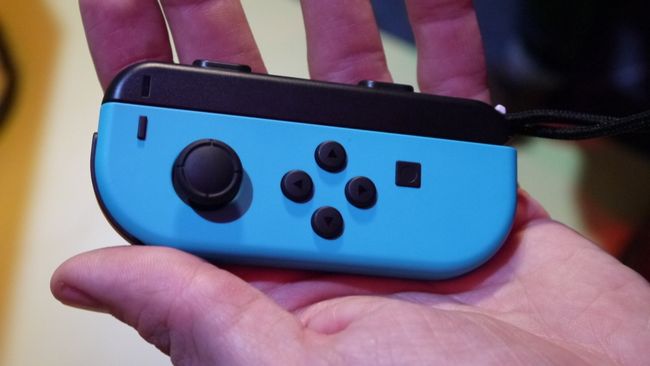
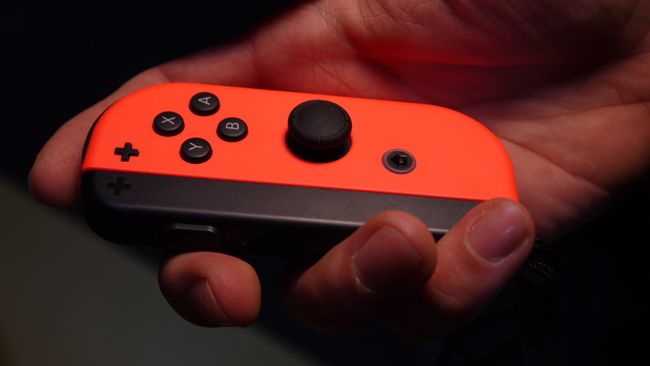
It’s a bit like the Wii remote / nunchuck pairing in use – you have a left-hand element that includes an analogue stick and direction buttons (sacrilegiously moving away from Nintendo’s iconic ‘cross’ design” in favor of separate buttons) alongside a ‘minus’ options button, a Capture button for recording gameplayand a top shoulder trigger. The right-hand element has a second analogue stick, the X, Y, A and B input buttons, another shoulder button, a ‘Plus’ start button and a Home button for jumping to the main interface.
These components can be used together, separately or combined with a central Joy-Con grip unit for a more traditional play experience. The ability to use each part as a solo pad also goes some way to explaining the removal of the old-school Cross pad – with the analogue stick used as a movement input, the other buttons then potentially can be used for action commands, with the pad turned on its side like a spruced-up NES pad.
One criticism so far, based on early play, relates to the right-hand side of the Joy-Con, when it’s being used in a single-controller scenario. As it’s asymmetrically placed when in the Joy-Con grip, this means that all its buttons and its control stick can feel very cramped together when it’s used in a solo configuration.
Each Joy-Con offers an accelerometer and gyroscope for motion controls, while the right Joy-Con also features NFC for hooking up Nintendo’s amiibo figurines. Nintendo is coining what it calls ‘HD Rumble’ for the controllers, which it claims lets you feel vibrations as subtle as a few ice cubes shaking around in a glass.
The right controller element also features an IR Motion Camera that can detect the distance and shape of objects in particular games – Nintendo offers the example of being able to play rock/paper/scissors with the console, though it does hint at further AR or VR ambitions down the line.
When removed from the tablet, the controllers feel quite unlike any others we’ve played with before. They’re incredibly light and very small too, which may prove fiddly for big-handed gamers. But they also prove responsive – playing the motion-based mini-games of launch title 1-2-Switch worked a treat, while the split D-Pad’s buttons are low-profile enough to allow for lightning-fast Street Fighter special moves. When removed from the tablet, each Joy-Con part can have a clip-on set of shoulder buttons slid onto their sides, too.
Again, the flexibility of the controller options makes for a very dynamic system. In theory, for example, you can get four players around one Switch console with two complete Joy-Con controllers, if each player uses an individual left or right side pad. The combinations seem confusing on paper, but in practice should be quite intuitive. Less clear at this point is how many controller in total the Switch supports, once you start including the more traditional Nintendo Switch Pro pads into the mix.
Though it was hard to get a proper sense of the weight of the tablet and Joy-Con controllers combined, due to the security housing Nintendo had wrapped them in, even with the additional safety measures everything felt very light, and certainly portable-friendly. However, it’s worth noting that the controllers are charged via the Switch itself, so make sure you’ve juiced both as fully as possible in the dock before heading on out; there’s no way to charge them separately.
Games: the launch lineup and beyond
But what’s a games console without the games? The Nintendo Switch has a number of both first- and third-party titles ready to go in the console’s first year, including big franchise hitters like Mario and Zelda, although the day one launch lineup is looking a little spartan.
The Legend of Zelda: Breath of the Wild appears the most compelling so far, set for release on March 3 alongside the Switch itself. It’ll be joined by 1-2-Switch, a title that makes full use of the controllers and little screen interaction to ensure players are looking into each other’s eyes, with mini-games including wildwest gunslinging.
ARMS, a multiplayer futuristic boxing game, uses the Joy-Con pads to throw punches, and will be ready “this spring”.
This is essentially Wii Sports boxing mode, spun out into an entire game, with rock-em-sock-em robot visuals. You’ll be able to pick different power-ups for each arm (controlled by a Joy-Con component in each hand), jumping and throwing flurries of punches at a split-screen opponent. At present, it’s hard to get a grip on just how much skill is involved, as opposed to the flailing limb equivalent of button-mashing – trying to tactically dodge a press event opponent who was windmilling, we didn’t stand a chance.
Mario Kart 8 Deluxe makes the superb racer portable, and introduces new courses, items and racers – it’ll be ready on April 28.
If you’ve played Mario Kart 8 on the Wii U, you’ll know what to expect here – the game is all but identical, except for the addition of some new items and racers. What you gain, however, is the flexibility of the Switch – this is Mario Kart, in all its HD glory, on the go. Being able to sit around a table with eight other players, each potentially with their own Switch tablet screen, connected over local Wi-Fi, could bring that Blue Shell hyper-competitive play to a whole new level.
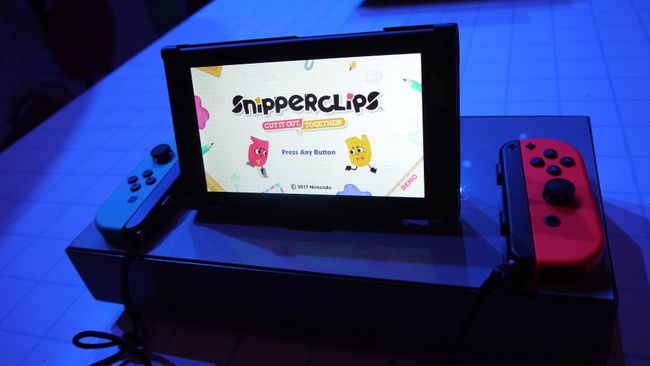
Paintball multiplayer shooter Splatoon 2 will be ready for the summer, while the surprisingly engrossing Snipperclips – Cut It Out Together! will launch in March; it’s puzzle game that enables you to cut shapes out and bring them into the game to help solve challenges.
So far, it’s our dark horse favorite from the whole event. Looking a little like Scribblenauts, players can take one Joy-Con component each, and use it to cut chunks out of each other’s paper player. This can then be used to line up with puzzle-solving shapes, or formed into tools to move items around the screen.
In one example, we cut our fellow player’s character into a shovel shape, so that she could scoop a basketball into a net. It’s very charming, and seemed perfect for playing sat next to another gamer in tablet mode, away from the big screen.
Xenoblade Chronicles 2, meanwhile, with its space-faring mechs, will keep RPG fans happy.
So where’s Mario? He’ll miss the launch, with Super Mario Odyssey arriving in time for Christmas. It sounds like it’ll be worth the wait, though, with Odyssey being the first ‘sandbox’ Mario game since Super Mario Sunshine on the GameCube, letting you explore wide-open worlds.
A number of third-party titles have also been teased, including EA’s FIFA, The Elder Scrolls V: Skyrim, NBA 2K, Project Octopath Traveler, Street Fighter II Ultra, Sonic Mania, Super Bomberman, Just Dance, Disegea 5, Dragon Quest’s X and XI, Fire Emblem Warriors, and Minecraft.
The issue, as was the case with the N64 and Wii U, will be retaining third-party support. The Switch’s unique hardware, like that of the Wii U, forces additional design considerations upon developers, which can become costly in gruelling development cycles. The Switch seems far more accommodating in this respect than the Wii U ever was, but it’ll be interesting to see if the chicken-and-egg scenario between playerbase and game catalogue can find a happy balance this time around.
Early verdict
The Switch is a confident showing from Nintendo at this early hands-on stage. Rather than falling on its sword and following the straightforward ‘box-under-your-telly’ design ethos, Nintendo has taken bold strides to once again mix up the gaming experience. Hopefully, third-party developers will make the jump into the unknown with it.
Flexible and fun, without feeling like a toy, the Switch is proving that Nintendo’s ideas can remain joyously novel without alienating the more po-faced of gamers. While on-the-go battery life and performance remain a concern until we can try out extensive real-world play on the Switch, Nintendo’s new machine is looking very promising; it just needs the games to make use of this innovative hardware.
With a price point set at £279.99 / $299.99 / AU$469.95, the Switch is going to have a mighty fight ahead of it against the relatively affordable PS4 and Xbox One bundles – and that’s before we learn more about the Xbox Scorpio, which we’d expect to be far more powerful, but far pricier.
Still, there’s nothing like pulling off a Super Mario triple jump, eh?
If you’ve ever idly looked at a shed online only to spend the next decade being followed around the internet by adverts for sheds, you’ll know that when you’re online you leave a footprint.
But you probably don’t realise just how many different organisations are tracking you online – and if you’re on a public Wi-Fi connection, how vulnerable your data may be. Hotspot Shield Free aims to protect your privacy and your data on Windows, Mac and on mobile devices too.
Why you need it
Hotspot Shield Free creates a virtual private network, or VPN for short. It keeps your online surfing anonymous, and has the happy side-effect of bypassing geographic blocks – so you can bypass those annoying “this video is not available in your country” messages on your favourite video sites, or blocked sites if you’re connecting at work or school. And if you’re connecting to public Wi-Fi, Hotspot Shield Free encrypts your communications so that the bad guys can’t intercept what you’re doing.
If you’re sharing secret stuff or just don’t want advertisers to track your every move, Hotspot Shield Free is a powerful ally.
We use cookies to ensure that we give you the best experience on our website. If you continue to use this site we will assume that you are happy with it.